
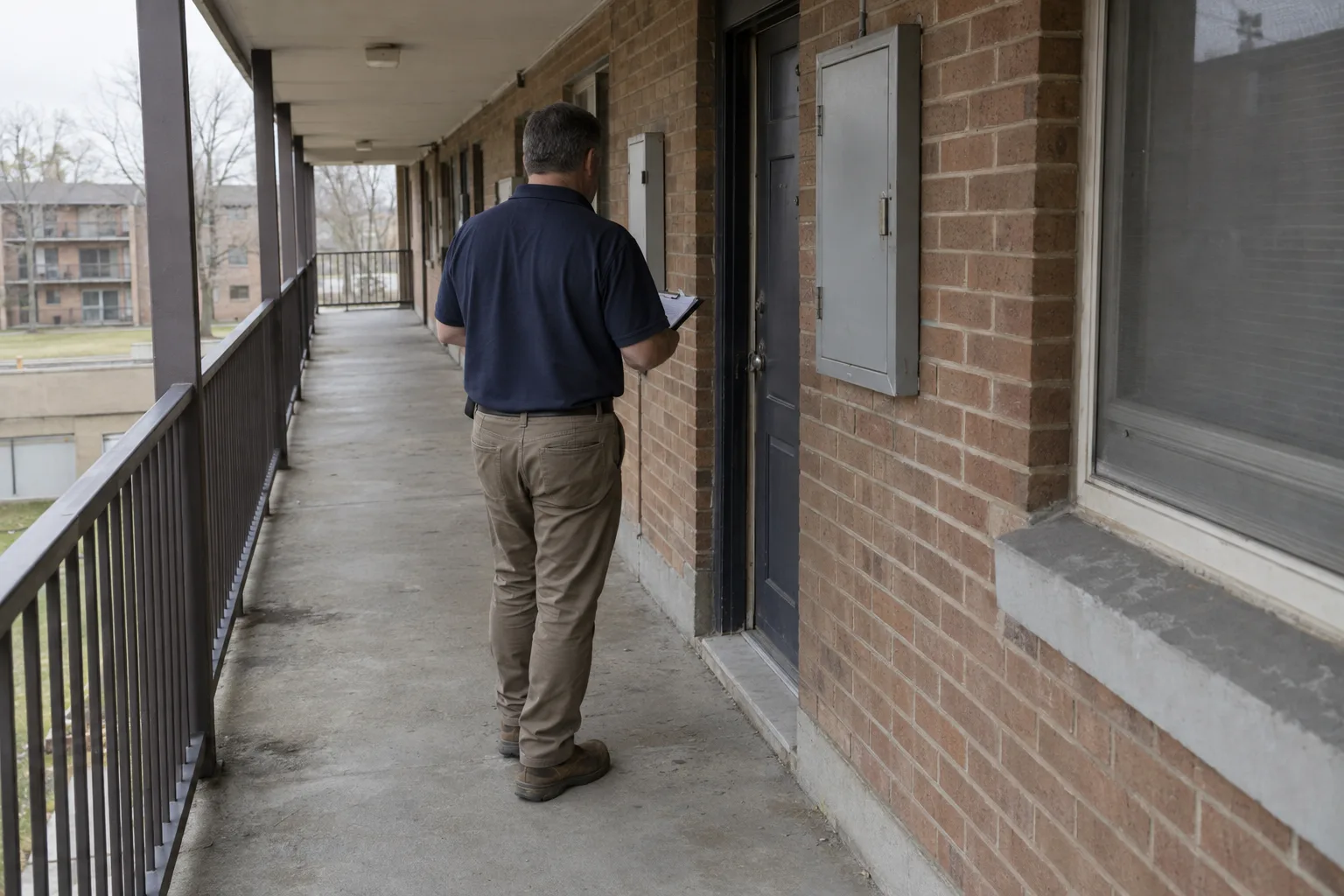
How Long Does Public Housing
Inspection Readiness
Take?
The honest answer depends on your property's current condition, your maintenance records, and how close your HUD inspection date is. Most properties need 2 to 8 weeks of focused preparation. Some need 48 hours. Here is how to tell which situation you are in.
What Actually Determines Your Readiness Timeline
There is no universal number. A well-maintained 40-unit building with current work orders and organized documentation can be ready in two weeks. A 200-unit complex with deferred maintenance, missing records, and multiple life-safety deficiencies may need six to eight weeks of structured remediation before it is safe to face a HUD inspector.
The three variables that drive your timeline are property condition, documentation quality, and inspection urgency. Property condition covers structural integrity, mechanical systems, smoke and CO detector compliance, and unit-level deficiencies visible to any trained NSPIRE inspector. Documentation quality means organized maintenance logs, unit inspection histories, and certifications for elevators, fire suppression systems, and boilers. Inspection urgency is simply how many days you have before HUD schedules the visit.
REAC NSPIRE Pros has operated in this space since 2000. In that time, the most common reason properties fail is not catastrophic physical failure -- it is the accumulation of deferred small deficiencies that score disproportionately under HUD's NSPIRE scoring model. A broken GFCI outlet in a bathroom may cost far more points than a cracked sidewalk. Understanding which deficiencies carry the heaviest scoring weight is where preparation strategy begins.
The Four Readiness Phases
If you want to understand exactly how HUD scores each deficiency category, the NSPIRE scoring calculation breakdown is a useful reference before you start prioritizing repairs.
When You Have Two Days
HUD sometimes provides short notice. Our 48-hour emergency pre-inspection exists for exactly this situation. We focus on life-safety deficiencies and highest-scoring items first, give you a prioritized correction list within hours, and work alongside your maintenance team in real time if needed.
The Standard Window
Most properties with moderate deferred maintenance and reasonably organized records need two to four weeks. This allows time to complete repairs, gather documentation, and run a mock inspection before the real one. This is the timeline most housing authority clients work within.
Heavy Remediation Needed
Properties with significant deferred maintenance, multiple life-safety findings, or units in poor condition need six to eight weeks minimum. Trying to compress this into two weeks creates a different risk: rushed repairs that introduce new deficiencies or fail shortly after completion.
Contact Us Directly
Same flat-rate standard in every state. We serve all 50 states.
What Inspection Readiness
Actually Requires
Readiness is not a single inspection visit. It is a structured process that covers physical condition, documentation, resident access, and strategic deficiency correction. Here is how each component works.
Pre-NSPIRE Inspection
A complete unit-by-unit and common-area walkthrough using HUD's current NSPIRE protocol. Every deficiency is recorded, categorized by severity (life-safety, major, minor), and ranked by scoring impact. You receive a written report within 48 hours.
NSPIRE replaced the older REAC protocol and weights deficiencies differently. If you are still preparing using REAC playbooks, your strategy may be misaligned. See how the two systems compare in our NSPIRE vs REAC breakdown.
NSPIRE Inspection Services →Pre-REAC Inspection and Consulting
For properties still operating under legacy REAC scoring, our pre-REAC service covers the same structured walkthrough with scoring-weighted deficiency reports. We also help you understand your current inspection frequency requirements based on prior scores, which affects how urgently you need to prepare.
Properties that scored below 60 on their last inspection face more frequent HUD reviews. That compressed timeline demands an accelerated readiness strategy, not the standard six-week approach.
Pre-REAC Services →Mock Inspection Services
A mock inspection runs the full HUD protocol on your property before the real inspection date. It catches items that survived the remediation phase and confirms that repair quality meets HUD standards rather than just visually passing.
A replaced smoke detector that was installed incorrectly will still fail. A patched wall with visible texture mismatch may or may not score -- knowing the inspector's discretion range matters. Our REAC mock inspection and NSPIRE mock inspection services both include re-inspection verification.
Mock Inspection Details →HQS Compliance for Section 8 and HCV Programs
Housing Quality Standards (HQS) inspections apply to Housing Choice Voucher and Section 8 units under the Project-Based Voucher program. The readiness timeline for HQS is typically shorter -- most units can be assessed and corrected within a week for routine findings -- but repeat failures trigger abatement, which stops HAP payments until the unit passes.
Common HQS findings include inoperable windows, missing or expired smoke detectors, leaking plumbing, and inadequate heating capacity. These are all correctable quickly if maintenance resources are mobilized immediately. The HQS inspection process and the Housing Choice Voucher compliance program are distinct tracks with different timelines and consequences.
For detailed HQS selection criteria, see our guide on choosing an HQS compliance inspection company.
Portfolio-Level Programs for Housing Authorities
Housing authorities managing 10 or more properties face a different readiness problem: they cannot afford to treat each inspection as an isolated event. A portfolio pre-inspection program establishes a rolling inspection schedule that keeps all properties in a continuous state of readiness rather than scrambling before each HUD visit.
The program typically covers quarterly walkthroughs, centralized deficiency tracking, maintenance team training on NSPIRE-specific standards, and documentation management. Properties enrolled in continuous programs consistently score higher because deferred maintenance never accumulates to the point of becoming a scoring liability.
Housing Authority NSPIRE Consulting →What About Failed Inspections?
The cost of inaction is always higher than the cost of preparation.
If you already failed an inspection, the readiness timeline starts differently. HUD issues a corrective action plan with specific deadlines. Missing those deadlines triggers escalating consequences including civil money penalties, flag designations, and in severe cases, loss of funding. Our post-failed HUD inspection recovery service is specifically designed for this situation.
Recovery timelines are HUD-mandated, not flexible. If you have 30 days to correct life-safety findings, you have 30 days -- not 45. We help you build the correction sequence, documentation trail, and re-inspection request in the format HUD expects. A score appeal is also possible in some cases; our HUD inspection score appeal consulting reviews your inspection report for procedural errors and scoring anomalies that may support a formal challenge.
For a full breakdown of the financial and operational impact of a failed inspection, see: How Much Does a Failed NSPIRE Inspection Cost?
Apartment Turnover and Unit Make-Ready
Vacant units are a hidden inspection liability. A unit turned over without HUD standards in mind may fail on the first inspector visit, costing more time and money than a properly executed make-ready. Our HUD-subsidized property turnover checklist covers the specific requirements that general maintenance protocols miss.
Capital Needs Assessment Coordination
Longer-term readiness sometimes reveals capital deficiencies that cannot be corrected with maintenance labor alone. Roof systems, HVAC infrastructure, elevator modernization, and plumbing distribution are examples. A Capital Needs Assessment documents these items in a format suitable for HUD financing applications, preserving your score while larger work is planned and funded.
Inspector Shadowing and Staff Training
Your maintenance team is your primary readiness asset. Inspector shadowing places one of our consultants alongside your staff during the real HUD inspection, providing real-time guidance on responding to inspector questions and documenting conditions accurately. Staff training teaches your team to identify NSPIRE-specific deficiencies during routine rounds, so findings are corrected continuously rather than in a pre-inspection rush.
The Paperwork Side of Readiness Takes as Long as the Physical Work
Most property managers underestimate documentation time. Physical repairs are visible and trackable. Missing certifications, expired boiler inspections, or incomplete work-order logs are invisible until the HUD inspector asks for them.
NSPIRE inspectors review documentation as part of the inspection. Specifically, they check elevator inspection certificates, fire suppression system service records, pest control logs, and unit inspection histories. If those records are missing or expired, the deficiency scores against you even if the physical system is functioning perfectly.
Gathering and organizing documentation typically takes five to ten business days for a single property, longer if certifications have lapsed and need to be renewed through licensed contractors or third-party inspectors. For a full checklist of what HUD inspectors want to see, our NSPIRE inspection documentation requirements guide covers each category by building system.
Must be current and signed by a licensed contractor. Annual or semi-annual depending on system type.
State-issued and must be posted in the cab. Expired certificates score as a life-safety deficiency.
Service logs, inspection dates, and licensed contractor sign-offs for the prior 12 months.
Dated logs showing scheduled treatments. Active infestation evidence in any unit scores as a major deficiency.
Demonstrates responsive maintenance. Unresolved open work orders in inspected units are a direct scoring liability.
Where Inspection Scores Are Won and Lost
The highest-scoring deficiencies under NSPIRE are life-safety items in units. Smoke detectors, CO detectors, electrical hazards, and missing or damaged handrails in stairs carry more weight than exterior cosmetic issues. This is a significant shift from the older REAC protocol, which weighted site conditions more heavily.
According to HUD's published NSPIRE standards, inspectable areas are now organized into three primary categories: Inside (units and common areas), Outside (site and building exterior), and Building Systems. Units carry the heaviest weighting. A property with 100 units where 30% have smoke detector issues will score far lower than one where only the exterior has minor cosmetic deficiencies.
Smoke/CO detectors, electrical panel deficiencies, inoperable egress windows, missing handrails
Elevator certifications, fire suppression systems, plumbing leaks in common areas, HVAC functionality
Damaged flooring, inoperable appliances, peeling paint in pre-1978 buildings, GFCI outlets near water sources
Cracked sidewalks, damaged fencing, poor exterior lighting, overgrown landscaping near buildings
For a full list of the most frequently cited issues, see: Top 10 Common HUD REAC Inspection Deficiencies and How to Fix Them and Common Violations in NSPIRE Inspections and How to Avoid Them.
Readiness Timeline by Property Type
Preventive Maintenance as a Long-Term Strategy
The fastest and cheapest way to be ready for a HUD inspection is to never fall behind. Properties that maintain quarterly internal inspection cycles using NSPIRE criteria rarely need more than two weeks of focused preparation before an actual HUD visit. The deficiency list stays short because issues are caught and resolved within 30 days of appearing, before they compound or spread to adjacent units.
Preventive maintenance also protects your score from the scoring model's unit-weighting structure. Under NSPIRE, a single deficiency that exists in 30% of your units multiplies across the sample. Finding and fixing that deficiency in February, six months before an August inspection, costs a fraction of what emergency remediation costs in July.
For more on how NSPIRE's scoring model amplifies per-unit deficiencies, see our NSPIRE standards overview.
Why Nationwide Coverage With Flat-Rate Pricing Matters
Housing authorities managing properties across multiple states run into a consistent problem: inspection standards are federal, but local consulting firms interpret and apply them differently. A pre-inspection in Mississippi may produce a different finding set than the same property condition assessed in Ohio, because the consultant's familiarity with HUD's scoring protocol varies.
REAC NSPIRE Pros applies the same protocol in every state, using HUD's published NSPIRE standards as the single reference point. Flat-rate pricing means your budget for a pre-inspection in South Carolina is the same as for a comparable property in Michigan. There is no travel-fee variable, no regional markup.
Our statewide pre-inspection services guide covers state-specific program structures and common local compliance requirements that layer on top of HUD's federal standards. See also our service in specific markets like Detroit, Michigan and South Carolina.
Inspection Readiness:
Specific Answers
Can I prepare for an NSPIRE inspection in less than a week?
Yes, if your property is already in reasonable condition and your documentation is mostly current. In that case, a 48-hour emergency pre-inspection identifies the highest-priority items, and a focused maintenance push over three to five days addresses them. You will not fix everything in a week, but you can resolve the deficiencies that cost the most points. The trade-off is that you leave lower-scoring items uncorrected, which may be acceptable depending on your prior score and current standing.
Does HUD give advance notice of NSPIRE inspections?
HUD typically provides a notification window before a scheduled REAC inspection, but the advance notice period has varied over program history and is subject to change. Under some HUD programs, inspections can be unannounced. This is precisely why continuous readiness -- not pre-inspection cramming -- is the most defensible strategy. The benefits of a structured NSPIRE preparation program include not having to react to an inspection notice with emergency measures.
How long after a failed inspection do we have to correct deficiencies?
The correction period depends on deficiency type. Life-safety findings typically require correction within 24 hours to 30 days depending on severity. HUD issues a formal corrective action timeline in the inspection results. Missing those deadlines is a separate compliance violation from the original deficiency. Contact us immediately after receiving a failed inspection result -- the first 48 hours of the recovery process matter significantly for both the correction timeline and any potential score appeal.
What is the difference between a pre-inspection and a mock inspection?
A pre-inspection is a diagnostic: it identifies existing deficiencies and produces a prioritized correction list. It happens before any repair work begins. A mock inspection runs the full HUD protocol on a property that has already gone through remediation, to verify that repairs were completed correctly and that no new deficiencies appeared during the work. Ideally, a readiness program includes both. The case for a pre-NSPIRE inspection and the value of a final mock walkthrough are complementary, not interchangeable.
Do you work with housing authorities on an ongoing basis, or only before inspections?
Both. Housing authorities that engage us on an ongoing portfolio pre-inspection program maintain rolling readiness across their entire inventory. This includes quarterly walkthroughs, centralized deficiency tracking, staff training, and documentation management. For authorities that only need help before a specific inspection, we provide one-time pre-inspection, mock inspection, and consulting services. The right engagement model depends on your portfolio size, budget, and inspection history.
Can you help us if our property is in a state you have not listed specifically?
Yes. We operate in all 50 states. HUD's NSPIRE standards are federal and apply uniformly regardless of state. Our consultants travel to properties nationwide and apply the same protocol and flat-rate pricing in every location. Whether you manage properties in rural Alabama or in urban Chicago, the inspection standard and our preparation process are identical. Contact us at (610) 200-2836 or info@reacnspirepros.com to discuss your specific portfolio and timeline.
Know Where You Stand Before HUD Does
In business since 2000 and operating in all 50 states, REAC NSPIRE Pros serves housing authority administrators, affordable housing property managers, and HUD-subsidized property owners who need structured, technically precise preparation. We do not guess at HUD's standards. We apply them the same way every time, in every state.