
Inspector shadowing
Findings get logged in silence
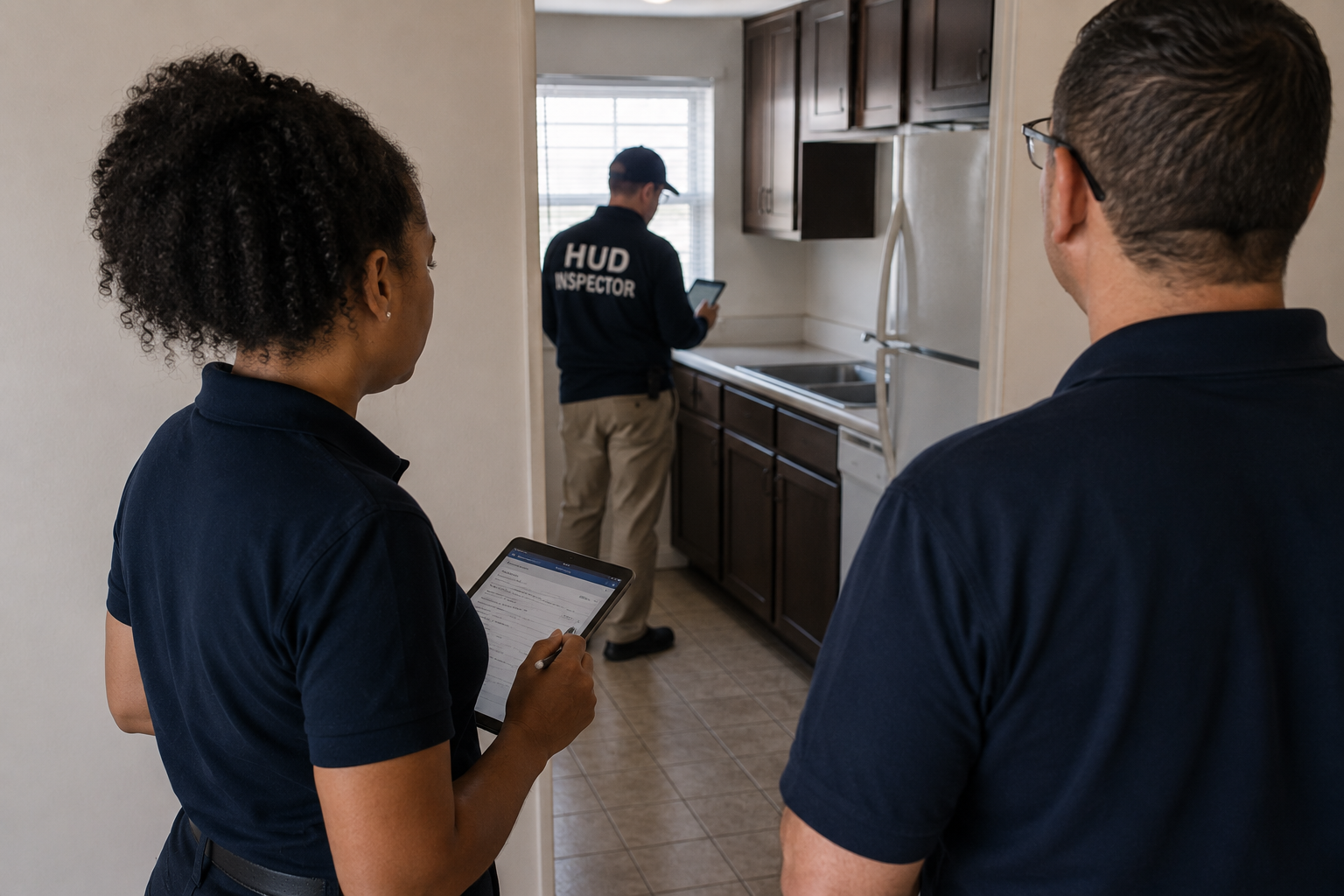
The inspector opens a door, scans the room, taps something into a handheld and moves on. No announcement, no explanation. Your manager two steps behind has no idea what was just recorded. We walk alongside and keep a parallel log you receive the same day.
Try it
The same inspection day, with and without someone watching
Step through the day to see what your team knows at each moment. The gap is not the findings, it is the delay before you learn what they were.
Timing of the official report varies. What does not vary is that findings are recorded silently during the walk, and that the correction clock on the most severe items starts from identification rather than from when you read about it.
What shadowing is
A trained observer, not an advocate
Inspector shadowing means a consultant is physically present during the official inspection, observing, documenting and classifying each finding as it is recorded. Our consultant walks alongside the inspector and builds a parallel record your team receives the same day.
Managers usually ask the same question first: does having someone there create friction? It does not, because the role is deliberately narrow. Our consultants observe professionally and without interference. They do not argue findings with the inspector during the walk. They track, document and hold.
The consultant attends as a property representative supporting the management team, which is an appropriate role during an inspection. The inspector's work continues uninterrupted; a second record simply runs alongside it.
What you get is the complete picture on the day: every observation logged, every severity classification noted, and a debrief within 24 hours of the walk closing explaining what the findings are likely to mean for the score. The written report follows inside 48 hours.
Shadowing works best after a pre-NSPIRE inspection rather than instead of one. The survey tells you what to fix; shadowing tells you what was actually recorded. If the result then looks wrong, score appeal consulting uses that log as its starting point.
What gets classified
Four tiers, and the top one starts a clock
Our consultant records the tier alongside each observation, which is what makes the parallel log useful rather than merely reassuring. Note that these are the NSPIRE classifications, not the retired UPCS vocabulary a lot of material still uses.
Life-threatening
Correction required within 24 hours of identification. Our consultant raises these with your team during the walk rather than in the debrief, because the clock starts when it is found.
Severe
Significant defects affecting health, safety or the function of a building system, without that immediacy.
Moderate
Defects reducing the condition or usability of a unit, area or component without a direct safety risk.
Low
Minor defects with limited impact on health, safety or function. Still recorded and still deducted.
Our protocol
Before the walk, during it, and after the score closes
Three phases, each tied to a specific inspection-day outcome. The third is the one most people forget to ask about.
- Consultant confirmed and assigned before your inspection date
- Pre-walk briefing on property layout, known risk areas and recent repairs
- Your team coached on inspection-day positioning and their documentation role
- Agreement on how life-threatening findings will be escalated on the day
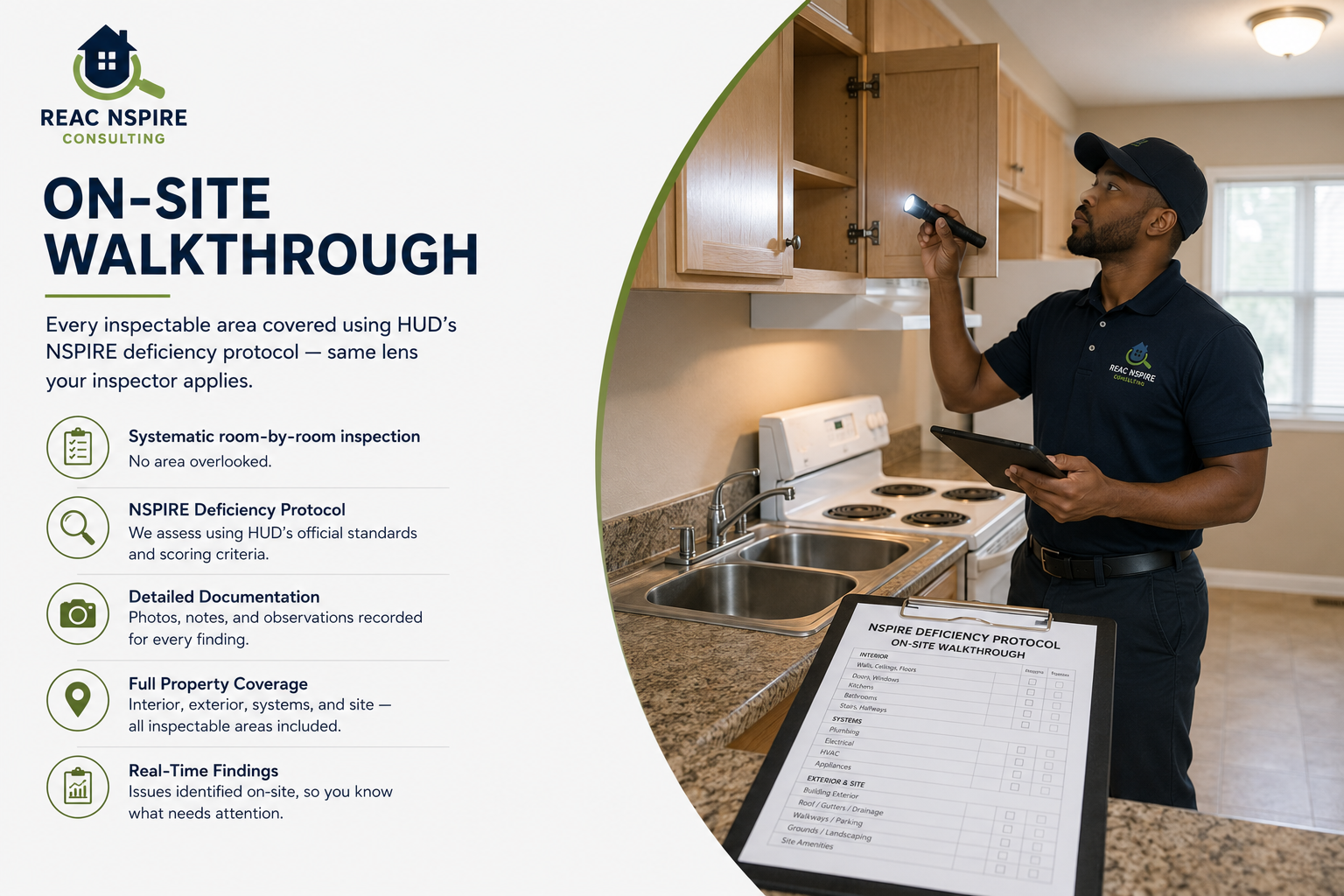
- Consultant shadows through every inspected area: units, building systems, site and exterior
- Each observation logged in real time with unit number, location and visible condition
- Severity classification recorded alongside every entry
- Life-threatening items flagged to your team immediately, not at the end
- Debrief within 24 hours explaining what the findings likely mean
- Written parallel log delivered inside 48 hours
- Log compared against the official report when it arrives
- Discrepancies identified, which is where an appeal case begins if there is one
Why the log matters later
You cannot dispute what you never saw
Weeks after the walk, an official report arrives listing findings against unit numbers. If nobody recorded what was observed at the time, there is no way to test whether a finding was classified correctly, recorded against the right location, or already corrected before the inspector arrived.
A contemporaneous log changes that. It does not guarantee an appeal succeeds, and nobody honest would claim otherwise. What it does is let you tell the difference between a finding you should accept and one worth examining, which is the distinction that decides whether an appeal is worth filing at all.
- Every observation timed and located as it happened
- Severity classification recorded at the point of observation
- Photographic support where conditions allow
- A basis for comparing the official report against the day itself
By the end of the inspection, dozens of findings have been recorded, and your team has seen none of them.Sam AmoyelleFounder, REAC Nspire Pros
Areas we serve
Regionally matched, in every state
Consultants are assigned before your date and positioned near the property, rather than travelling cross-country at short notice.
Received your inspection notice? Book before the date
We confirm a consultant within 24 to 48 hours of your request. Once the walk has happened, this window has closed.
Frequently asked
Inspector shadowing questions
What does inspector shadowing cost?
Flat rate, with no hourly billing and no variable charge based on how many findings are logged during the walk. One price, confirmed before your consultant is assigned.
Call or email with your property type, unit count and state for a direct quote.
How far in advance do we need to book?
We can usually confirm a consultant within 24 to 48 hours of your request, so a short notice period is workable. Earlier is better because it allows a proper pre-walk briefing.
The one thing that cannot be worked around is booking after the fact. Once the walk has happened there is nothing to observe, and reconstructing it from memory is not the same thing.
Won't a consultant interfere with the inspector?
No, because the role is deliberately narrow. Our consultants observe and document. They do not raise findings with the inspector during the walk or attempt to influence a classification.
The consultant attends as a property representative supporting your management team, which is an appropriate role during an inspection. The inspector's work is not interrupted.
Why not just review the official report when it arrives?
Two reasons, one of them time-critical. Life-threatening findings carry a 24-hour correction requirement running from identification, not from when you read about them. A finding logged on the day gives your team the chance to act within that window.
The other is that a report tells you what was concluded, not what was observed. Without a contemporaneous record you have no basis for testing whether a finding was classified correctly or recorded against the right unit.
Can the parallel log be used in a score dispute?
It can support one, and it is often what makes a case possible at all. But it is not evidence in its own right and no consultant's log overrides an inspector's record.
Its real value is telling you which findings are worth examining. Filing a challenge on everything weakens the points that would have succeeded, and the log is how you tell those apart.
What happens after the inspection closes?
The debrief happens within 24 hours of the walk closing, and the written log follows inside 48 hours. When the official report arrives, we compare it against what was recorded on the day.
That comparison is the point of the whole exercise. It tells you whether the report reflects what happened, and where it does not.
Should we do this instead of a pre-inspection?
No, alongside it. They do different jobs: a pre-inspection tells you what to fix while there is still time, and shadowing tells you what was actually recorded on the day.
If you can only do one and the date is still some way off, do the pre-inspection. It is the one that can still change the outcome.
Do you shadow in every state?
Yes, with consultants assigned before your date and matched regionally, so they are already positioned near the property rather than travelling at short notice.