
NSPIRE repair services
The scoring engine does not reward effort
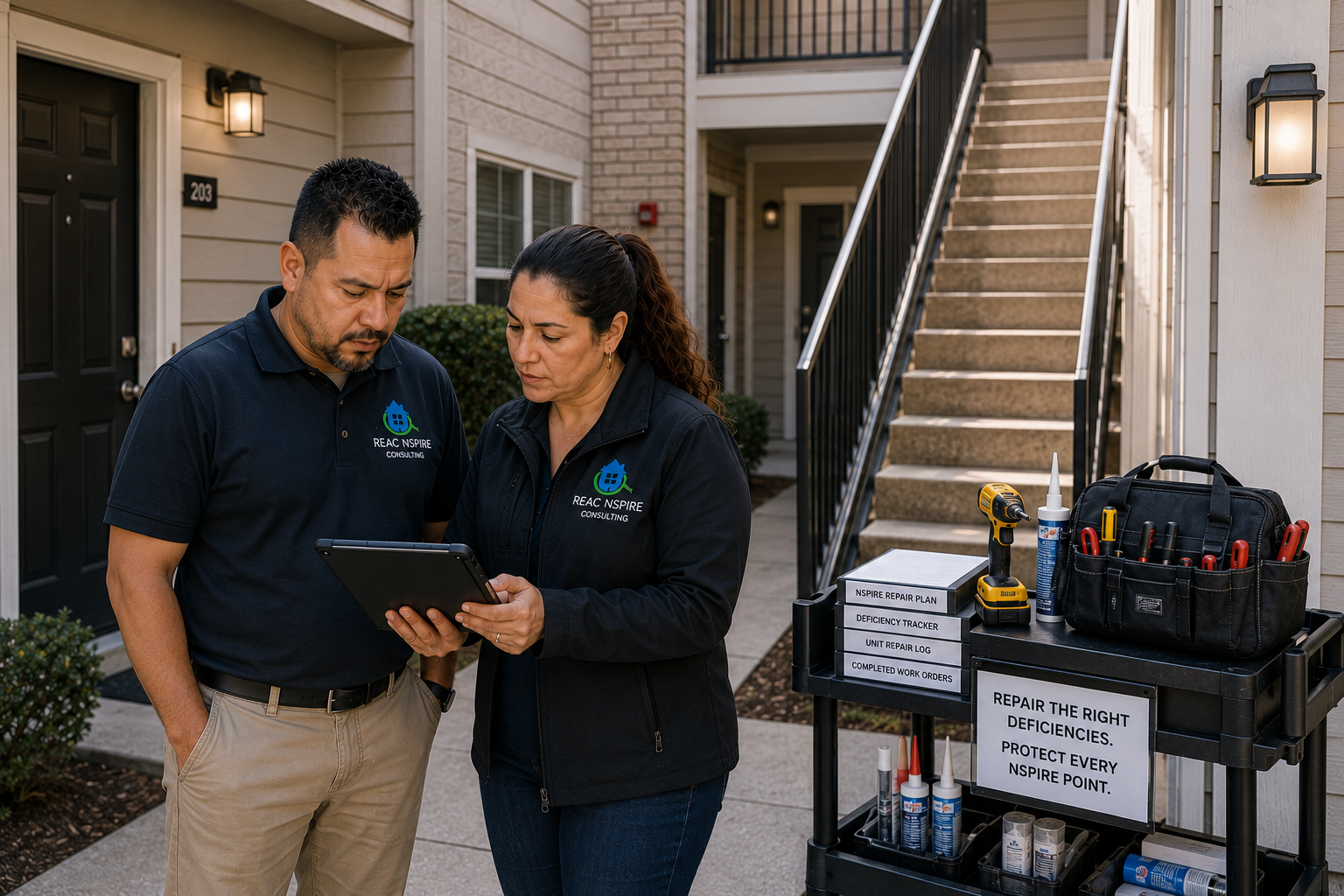
It rewards the right items closed in the right order. A crew can work three weeks straight and protect very few points, because nobody mapped the work to severity. We produce a written remediation plan in 48 hours, sequenced by what each item costs you.
What we see most often
Three weeks of real work, and a disappointing score
A maintenance crew worked three weeks straight before their inspection. Paint touched up. Flooring replaced. Common area lights swapped. The inspection happened on schedule and the score came back lower than anyone expected.
Two bathroom extract fans had been inoperable the whole time. One unit had a missing smoke alarm. Nobody prioritised those items because nobody had mapped the work to severity.
The effort was real. The outcome was not protected. That is the gap this service closes, and it is almost never a competence problem. It is a sequencing problem, and sequencing is invisible unless someone has scored the list first.
Where the same findings return cycle after cycle, the answer is usually a component at the end of its life rather than another repair round, which is what a capital needs assessment establishes. For the survey that produces the list in the first place, see NSPIRE inspection.
Try it
Same crew, same three weeks, same list
One difference: the order. Switch between the two and look at what is still open on inspection day.
Both crews did the same amount of work. The difference in outcome comes entirely from which items were still outstanding when the inspector arrived, and severity is what decides how much that costs.
Our framework
Severity-first sequencing, in order
Every remediation plan follows the same structure. These are the NSPIRE severity tiers, which replaced the UPCS vocabulary a great deal of published guidance still uses.
Correct within 24 hours
Smoke and carbon monoxide alarms, blocked egress, exposed conductors, fire suppression gaps. Nothing else on the list is negotiable until these are closed, because the clock runs from identification rather than from when the report is read.
Correct within 30 days
Significant defects affecting health, safety or the function of a building system. Structural and mechanical failures sit here, and they carry substantial weight without the immediacy of the tier above.
Correct within 30 days
Defects reducing the condition or usability of a unit, area or component without a direct safety risk. Much of what a maintenance team would do anyway, once the tiers above are secured.
Correct within 60 days
Minor defects with limited impact on health, safety or function. Still recorded and still counted, so worth closing if budget and labour remain, but never before the tiers above.
The principle is straightforward and routinely inverted in practice. A property that resolves thirty low-tier items while leaving two life-threatening deficiencies open has spent significant labour protecting very little, and has kept a 24-hour obligation open the whole time.
What makes it hard is that the low-tier items are usually the visible ones. They look like progress when ownership visits. The heavy items are frequently behind a door nobody opened.
Standards
What the remediation plan contains
Not a document to interpret. A work order sequence anchored to the same framework the inspection applies.
Every deficiency logged and classified
Recorded during the walkthrough using the inspection protocol, photographed, and assigned to a severity tier at the point of observation rather than sorted afterwards.
Score-impact review on each item
An assessment of what remains at risk if the item is left open, which is the foundation of the sequence. Without it, a maintenance supervisor is working from instinct and instinct reliably picks the visible items.
Sequenced work order document
Ordered by severity and consequence rather than by trade, floor or building. That ordering is the entire deliverable, and it is what a general punch list cannot produce.
Correction deadlines attached
Each item's required window stated against it, so the 24-hour obligations are unmistakable and nothing sits in a queue that should have been closed the same day.
Photographic documentation at every stage
Every deficiency photographed before repair and every resolved item photographed after. That record supports reinspection confirmation and is worth considerably more than documentation assembled later.
Written in terms your crew can act on
Plain language describing the condition and the correction, without needing the regulation explained first. Delivered within 48 hours, flat rate, no scope surprises and no hourly billing.
Inside our engagement
Three stages, one documented standard
Logged, photographed, classified
A full property walkthrough using the inspection protocol. Every deficiency is recorded, photographed and assigned a severity tier as it is found.
Scored and sequenced
Within 48 hours you receive a written plan. Not a generic checklist: a sequenced work order document organised by severity, with the correction window against each item.
Resolved, not just addressed
After your team completes the sequence, we return to verify each documented deficiency has been resolved in a way that satisfies the standard rather than addressed in appearance.

Coverage
Deployed to every state from Philadelphia
We serve housing authorities, property management companies and multifamily operators in all 50 states, dispatching from our Philadelphia hub through a field team of 50+ consultants.
That scale allows simultaneous deployment across several properties and regions, which matters for portfolio operators facing overlapping inspection windows rather than one date.
- Flat rate nationwide, with no regional surcharges
- Simultaneous deployment across multiple properties
- One plan format, so properties can be compared
- Reinspection available wherever the property sits
NSPIRE scores deficiency severity, not repair volume. Sequence controls the outcome.Sam AmoyelleFounder, REAC Nspire Pros
Areas we serve
Every state, same standard, same flat rate
Engagements run identically whether the property is in Philadelphia, rural Oklahoma or coastal California.
A repair plan ranked by what it costs you not to fix
Tell us your property type, scope and inspection window. Flat rate, quoted before anyone walks the property.
Frequently asked
NSPIRE repair questions
How much does an NSPIRE repair engagement cost?
Flat rate for every engagement regardless of location or state. No distance surcharges, no per-unit fees and no variable charge based on how many findings are surfaced.
Call with your property type and scope for a quote specific to the work.
How quickly can the work begin?
The diagnostic walkthrough can usually be scheduled within days, and the written plan follows 48 hours after it. Your crew can start on the sequence as soon as the plan lands.
If your inspection window is tight, say so on the first call. We will tell you what fits in the time available rather than producing a plan nobody can complete.
Does the plan include photographs, or just a written list?
Photographs throughout. Every deficiency is photographed before repair and every resolved item afterwards, which matters for two reasons: your crew can see exactly what was meant, and the record exists before anyone official looks at the property.
Do you carry out the repairs yourselves?
The engagement is consulting: the assessment, the sequenced plan and the reinspection confirming the work satisfied the standard. Your own crew or contractors do the work.
That is worth being clear about, because it is the most common misunderstanding about this service. What we are selling is knowing which order to work in, not the labour.
Is a consultant available after the plan is delivered?
Yes, through the correction period. Questions on specific findings, clarification on what a correction needs to achieve, and confirmation on whether completed work meets the standard.
The reinspection is the formal version of that, and it is where the difference between resolved and addressed usually shows up.
Do you work in every state?
All 50, from our Philadelphia dispatch hub through a 50+ consultant field team, with no geographic exclusions and no regional surcharge. The same flat rate applies wherever the property sits.
What property types and programmes do you support?
Public housing, Section 8 project-based multifamily, Section 202 and Section 811 properties, RAD-converted and mixed-finance assets, and voucher-assisted units.
Mixed portfolios are common and worth mentioning early, because different programmes are currently on different compliance timetables.
We keep repairing the same things. Is that a sequencing problem?
Probably not. Where the same finding returns cycle after cycle, the usual cause is a component at the end of its service life rather than a repair done badly or in the wrong order.
Repairing it again produces the same finding next time. That is a capital planning conversation, and it is worth having before another repair round rather than after.