
REAC consulting
A good score last cycle protects you next time not at all
Consulting is the work between inspections: understanding why a score landed where it did, fixing the causes rather than the symptoms, and going into the next one prepared. Written reports in 48 hours, flat rate, all 50 states.
Start here
Where are you right now?
Consulting means different work depending on where you are in the cycle. Pick the closest and see what we would actually do, how long it takes, and what it costs you to wait.
Worth being precise about
REAC is still active. The protocol is what changed.
People search for REAC because that is what the industry has called these inspections for twenty years, and they are asking about something real. The Real Estate Assessment Center is HUD's office for scoring physical condition, it has not been replaced, and it is still inspecting.
What changed is the standard it applies. NSPIRE replaced UPCS in October 2023 for public housing and multifamily programmes. So if your property is being inspected today, it is being inspected by REAC under NSPIRE, whatever the correspondence calls it.
That matters for preparation. Guidance built on the old framework points at the wrong priorities, and there is a great deal of it still circulating. The most common example is the five inspectable areas: site, building exterior, building systems, common areas and dwelling units. That was the UPCS structure. NSPIRE uses three.
The voucher programmes are a separate case, and there the transition genuinely is still running with a compliance date of 1 February 2027. That is covered under HCV compliance.
For the inspection itself and how it is scored, see REAC inspection. This page is about the consulting work around it.
The scoring structure
Three inspectable areas, weighted differently
Your maintenance punch list was not built around these, which is usually why the work done and the score achieved do not match. Every finding we record is mapped to its area.
Inside the unit
Conditions in a sampled dwelling unit. This carries the most weight of the three, and there is a threshold rule that catches properties out.
- Alarms, electrical, heating and plumbing
- Windows, doors, locks and egress
- Kitchen and bathroom function
- Lose 30 points here alone and the score adjusts to 59
Inside the building
Common areas and the systems serving every resident. What was previously split between common areas and building systems now sits here.
- Corridors, stairwells and lobbies
- Emergency lighting and fire doors
- Mechanical, electrical and boiler rooms
- Lifts, laundry and community spaces
Outside
Site, grounds and building exterior. What was previously split between site and building exterior. The most visible area and the least heavily weighted.
- Walkways, parking and drainage
- Roofing, gutters and cladding
- Exterior lighting and handrails
- Refuse storage and site amenities
The practical consequence for older stock is worth stating. Ageing buildings carry more embedded deficiencies in systems and exterior components than newer construction, and that is simply the physical reality of managing legacy affordable housing. But those two areas are no longer where the heaviest weighting sits, so a repair programme aimed at them will feel productive and score modestly.
Inside our engagement
Three stages, one documented standard
Confirmed in a business day
We confirm property location, HUD programme type and your estimated inspection window, then assign a field consultant. Typically scheduled within one business day of the call.
Ranked by scoring impact
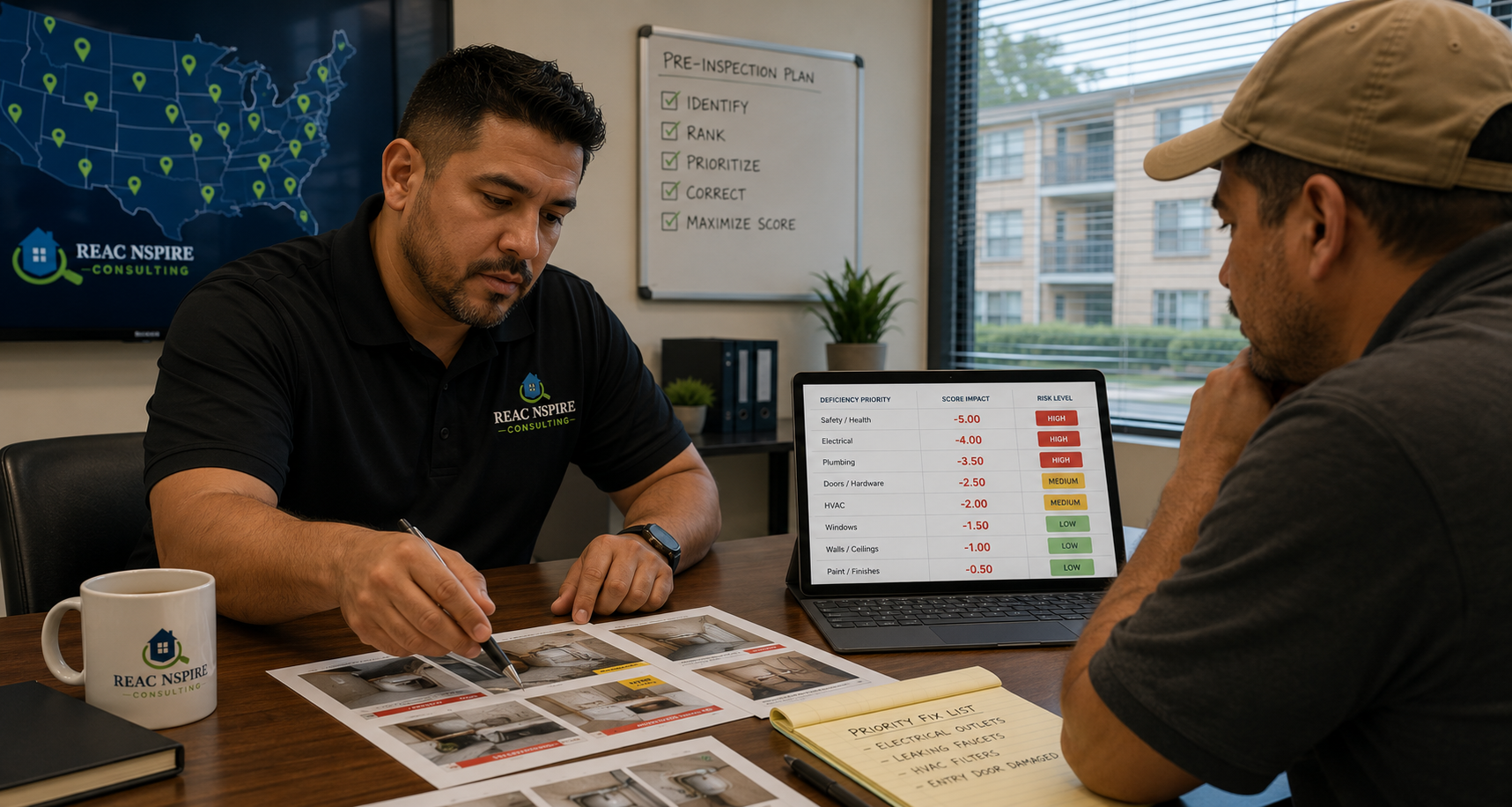
Within 48 hours of the walkthrough: every documented deficiency, its inspectable area, its severity, and a remediation list ordered by what each item costs rather than by where it sits.
Verified, not assumed
After repairs, a follow-up walkthrough confirms deficiencies have actually been resolved rather than addressed at the surface. You go into the inspection with verified corrections.

Coverage
Philadelphia hub, national field network
Our Philadelphia base puts the team within same-day range of major HUD-assisted concentrations across Pennsylvania, New Jersey, Delaware, Maryland and New York. Beyond the Mid-Atlantic we deploy through a national field network of 50+ consultants.
The Northeast corridor holds one of the densest concentrations of HUD-assisted housing in the country, and much of it is ageing. Working in that environment since 2000 is where the methodology came from, and it has since scaled to portfolios in Texas, Florida, the Midwest and the Southeast.
- One firm and one standard, single asset or multi-state portfolio
- Flat rate everywhere, with no distance surcharge
- Consistent report format so properties can be compared
- Portfolio engagements scheduled and reported together
A strong REAC score from one cycle does not protect you in the next.Sam AmoyelleFounder, REAC Nspire Pros
Areas we serve
Every state, same standard, same flat rate
Engagements run identically whether the property is in Philadelphia, rural Oklahoma or coastal California.
The time to prepare is before you know the date
Tell us your property type, unit count and state. A consultant is typically assigned within one business day.
Frequently asked
REAC consulting questions
Is REAC consulting still relevant, or has NSPIRE replaced REAC?
REAC has not been replaced. It is HUD's Real Estate Assessment Center, the office that inspects, and it is still inspecting. NSPIRE replaced UPCS, which was the standard REAC used to apply.
So the work is as relevant as it ever was. What changed is the framework preparation has to be built on, and that is exactly why guidance written before October 2023 misleads.
What does a pre-REAC consulting engagement cost?
Flat rate, with no hourly billing and no variable charge based on how many deficiencies are found. One price, confirmed before the consultant walks the property.
Call or email with your unit count, property type and state for a direct quote.
How quickly can we go from first contact to a written report?
A consultant is typically assigned and scheduling confirmed within one business day, and the written report follows within 48 hours of the walkthrough completing.
The constraint is rarely us. It is how long the repairs identified will take, which is why the useful conversation is about your inspection window rather than our availability.
What does your report include that our own walkthrough does not?
Mostly the ordering. Your team knows what is broken. What is harder to establish, without working from the published standards, is which of those items carries a heavy deduction, which inspectable area it falls in, and therefore what to do first.
A punch list built around trades and buildings produces a different repair order from one built around scoring weight, and the second is the one that moves a score.
Why not use a general building inspector with HUD experience?
A building inspector assesses against code. This assessment is against the federal standard your score is calculated from, and the two overlap without being the same thing.
A property can be entirely code-compliant and still lose points, because the standard tests items and conditions local code does not address at all.
Do you provide support after the report is delivered?
Yes. A follow-up walkthrough after repairs confirms each documented deficiency has actually been resolved rather than addressed superficially.
That verification is where the value sits. A repair that looks complete but leaves the original condition in place will still be recorded, and you would rather learn that beforehand.
Our score was fine last time. Do we need this?
A good result reflects the property's condition on one day, against one sample of units, under the standard applied then. None of those three carries forward.
Sampling in particular means a strong score can coexist with real problems that simply were not drawn. That is not a reason for alarm, but it is a reason not to treat one result as evidence about the next.
We keep getting the same findings every cycle. Why?
Usually because the component has reached the end of its life rather than because the repair was done badly. Repairing it again produces the same finding next time, and the honest answer is a capital conversation rather than another repair cycle.
That is worth establishing before spending, and it is what a capital needs assessment is for.