
PBV compliance
PBV income does not stop at the building. It stops at the unit.
A failed inspection does not cost you a percentage of a property score. It costs you the assistance payment on every unit that failed, individually and simultaneously. We assess and report every at-risk unit within 48 hours.

Try it
What a failure rate actually costs you
Not a score, not a percentage. A count of assistance payments interrupted at the same time. Move the sliders to see the arithmetic on your own portfolio.
Arithmetic only, using your own numbers. It does not predict a failure rate or a dollar figure, because both depend on your portfolio and your contract rents. What it does show is that PBV exposure scales by unit rather than by property.
How PBV subsidy works
Abatement is a cash flow problem, not a compliance one
Under the Project-Based Voucher programme, assistance is attached to a specific unit in a specific building rather than to the tenant. A failed inspection does not penalise the whole property at once. It penalises each unit individually.
Take eighty PBV units with fifteen failing. You do not lose a share of a building score. You lose fifteen separate housing assistance payments simultaneously, and abatement follows fast: the formal suspension of payments on any unit that failed and was not corrected inside the required window.
One missed life-safety item. One deficiency in a severity tier nobody expected. One unit that should have been cleared before the inspector arrived. That is not a compliance problem, it is a cash flow problem, and it lands before anyone has finished reading the report.
The programme is governed by 24 CFR part 983, and your housing authority's administrative plan sets the detail. Where assistance moves with the household instead, HCV compliance applies.
Worth checking before you spend
Which standard your PBV units are judged against
The regulation defining Housing Quality Standards now refers to the NSPIRE standards. But HUD has deferred the compliance date for the voucher programmes, project-based voucher included, three times, and it currently sits at 1 February 2027.
Still on legacy criteria
Your authority may keep inspecting to the familiar criteria until the compliance date, and many are doing exactly that. Preparing against NSPIRE weighting early spends money in the wrong places.
Transitioned early
An authority may adopt the NSPIRE-referenced definition ahead of the deadline, having notified HUD. Where that has happened, a legacy checklist leaves gaps and severity drives the outcome.
Everyone eventually
The current compliance date. It has moved three times, so treat it as the present position rather than a fixed one and confirm with your authority.
Whichever applies, the unit-level exposure above is unchanged. It is the criteria that vary, not the fact that abatement follows a failed unit. Establishing which framework your authority uses is a two-question phone call, and we do it before surveying rather than assuming.
Severity
Four tiers, and each sets its own deadline
Severity determines both how much a finding hurts and how quickly it has to be corrected. These are the NSPIRE classifications, which differ from the retired UPCS vocabulary still in wide circulation.
Life-threatening
Immediate risk to residents. In a PBV unit this is the tier that triggers abatement fastest, because the window is shortest.
Severe
Significant defects affecting health, safety or the function of a building system, without that immediacy.
Moderate
Defects reducing the condition or usability of a unit, area or component without a direct safety risk.
Low
Minor defects with limited impact on health, safety or function. Still recorded, still counted.
Standards
A unit-by-unit risk report before inspection day
Organised by unit, severity and subsidy exposure, because that is the order the financial risk actually falls in.
Unit-by-unit findings
Each unit assessed individually with findings documented photographically, rather than a property walkthrough that produces one aggregated list.
Severity classification on every finding
Life-threatening, severe, moderate or low assigned to each one, so the correction deadline attached to it is explicit rather than something you look up afterwards.
Subsidy exposure ranking
Units sorted by financial risk so your maintenance team starts where abatement is most likely, not at unit 101 because that is where the corridor begins.
Correction deadlines stated
Each finding's required repair window noted explicitly against it, which matters most for the 24-hour items where the clock starts at identification.
Remediation guidance
Written recommendations for resolving each deficiency, prioritised by exposure, in terms whoever does the work can act on directly.
Documentation ready for correspondence
Structured for use in correspondence with the housing authority and in submissions, so the report does not need rewriting before anyone else can read it.
Inside our engagement
Three stages, one documented standard
Scope and scheduling
State, unit count, programme type and your anticipated inspection window. We confirm consultant availability and schedule the assessment, with urgent situations flagged for priority dispatch.
Classified as we go
Findings compiled and classified by severity immediately after the visit, with units ranked by subsidy exposure. The units carrying life-threatening findings and the shortest deadlines appear first.
Delivered and walked through
Your report is delivered digitally within 48 hours, and we are available to go through the findings with your property manager or regional director rather than leaving you to interpret it.
Why it has to be a trained consultant
Maintenance issues and scored deficiencies are not the same list
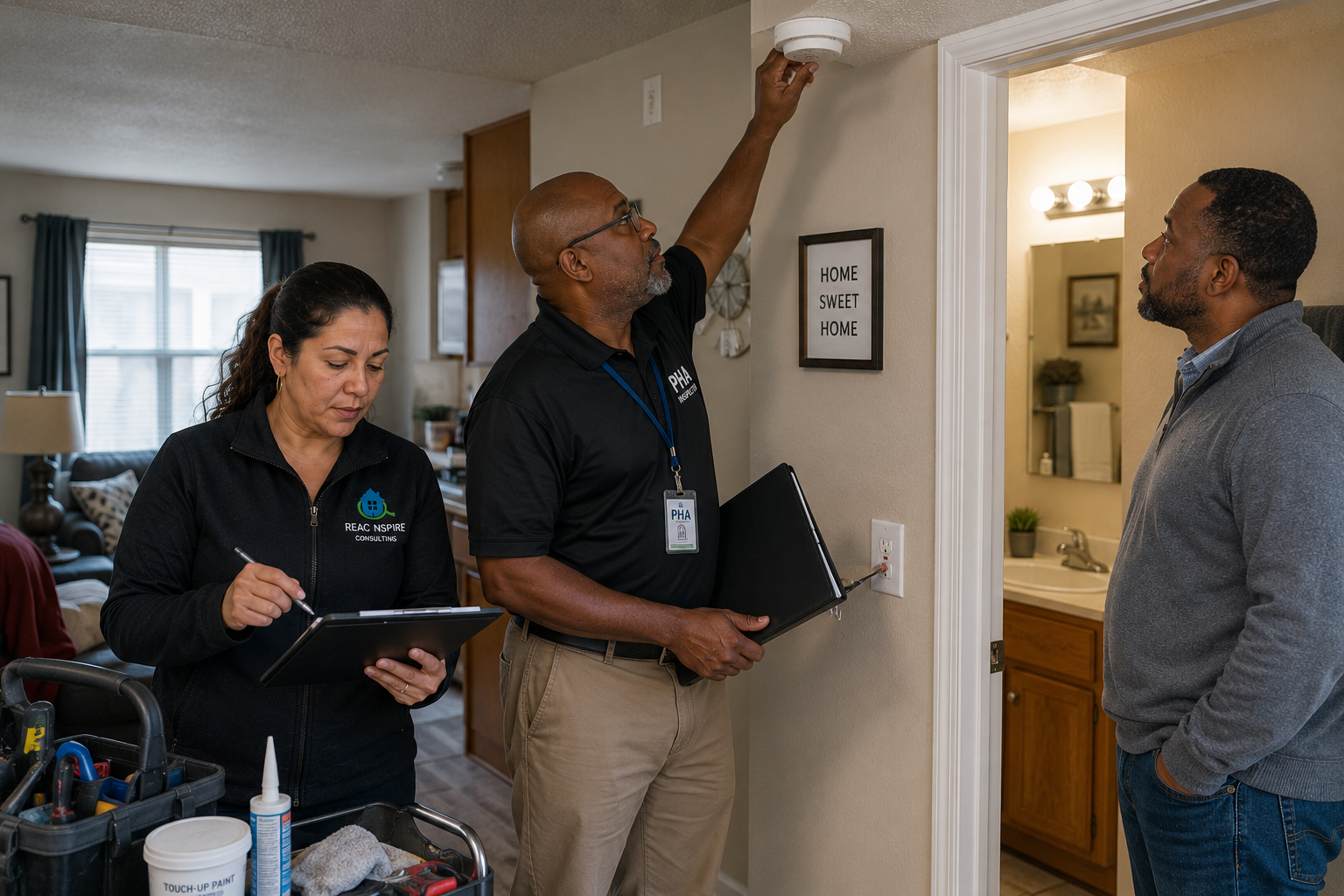
A general building inspector walks your units and flags maintenance issues. A trained consultant walks the same units and flags scored deficiencies, specifically the ones that will appear on the observation record and put a payment at risk.
That distinction is the whole of what pre-inspection preparation buys. The two lists overlap, but the items on one and not the other are exactly the ones that cost money.
Our team has worked under HUD inspection standards since 2000, through the move from UPCS into NSPIRE, and our reports are written in the deficiency language the authority uses rather than in general contracting terms.
- Scored deficiencies identified, not just maintenance issues
- The applicable standard established before surveying
- Reports written for authority correspondence
- Units ranked by what is actually at risk
A single life-safety deficiency in a PBV unit can trigger abatement before you realise what happened.Sam AmoyelleOwner, REAC Nspire Pros
Areas we serve
Every state, same protocol, same flat rate
Each region carries its own pressures. Texas properties contend with heating and cooling stress. Florida portfolios see moisture findings appear quickly after storm events. California operators navigate LIHTC and HUD requirements at once.
Book before HUD schedules the inspection, not after
Tell us your unit count, state and inspection window. Scheduling is confirmed at booking.
Frequently asked
PBV compliance questions
What does a PBV compliance assessment cost for 80 or more units?
Flat rate within your property size tier, with no per-unit fees and no variable charge based on how many deficiencies are found. One price confirmed before any consultant is scheduled.
Call or email with your unit count, state and inspection window for a direct quote.
How long from first contact to a unit-by-unit report?
Scheduling is confirmed at booking and the report is delivered within 48 hours of the assessment completing. On-site time scales with unit count rather than with property size.
For a portfolio spread across several states, we schedule together so the reports arrive in a comparable format rather than piecemeal.
Why is unit-level preparation different from a building walkthrough?
Because the financial consequence is unit-level. A building walkthrough produces one aggregated list, which tells you the property's general condition but not which specific units put a payment at risk.
Under PBV, fifteen failed units means fifteen interrupted payments. A report that cannot tell you which fifteen is not much use for deciding where the maintenance team starts on Monday.
We manage the property closely. What would you find that we have not?
Usually the same conditions, classified differently. Your team knows what is broken. What is harder to know, without working from the standards, is which of those items is a scored deficiency and which tier it falls in.
An alarm past its date and a scuffed skirting board look equally minor on a walkthrough. Only one of them can interrupt a payment.
Do you have direct experience with authority-managed PBV properties?
Yes. We have worked with housing authorities administering voucher programmes and preparing their own portfolio properties, as well as with private owners holding PBV contracts.
That matters because the authority's administrative plan governs the detail, including inspection intervals and any items added to the life-threatening list locally.
Do repairs have to be verified before the official inspection?
Not formally, but it is the difference between believing a unit is ready and knowing it. We offer a follow-up walkthrough confirming each documented deficiency has actually been closed.
A repair that addressed the symptom and left the underlying condition will still be recorded, and finding that out on inspection day costs a payment.
Is PBV the same as project-based Section 8?
No, and confusing the two is expensive. Project-based Section 8 is a separate programme with its own contracts and its own submission machinery, including monthly vouchering through TRACS.
PBV runs under the voucher programme at 24 CFR part 983, administered by the housing authority. Applying one programme's procedures to the other is where a surprising number of findings originate.
When is the cheapest time to clear a PBV unit?
During turnover, while the unit is vacant. Access is unrestricted, nothing needs coordinating with a resident, and corrections take hours rather than days.
Once a household is established, every correction needs notice and scheduling, and some become genuinely disruptive rather than merely inconvenient.