
REAC inspection consulting
Your REAC score is decided before the inspector arrives
We survey the property the way the inspection will score it, rank every finding by what it costs you in points, and hand back a sequence your team can execute. 50+ consultants, all 50 states, written report inside 48 hours.

First, the thing everyone asks
REAC and NSPIRE are not two competing systems
This is the most common misunderstanding in the field, and a great deal of published guidance gets it backwards. The two words describe different things entirely.
REAC
HUD's Real Estate Assessment Center. The office that conducts physical inspections of assisted housing and issues the score. It has not been replaced and is not going anywhere.
NSPIRE
The National Standards for the Physical Inspection of Real Estate. The standard REAC now applies, item by item, weighted by severity and by where the defect sits.
UPCS
The Uniform Physical Condition Standards. This is what NSPIRE replaced, in October 2023. Advice written for UPCS uses different vocabulary and points at the wrong priorities.
So if your property is being inspected today, it is being inspected by REAC under NSPIRE, whatever the correspondence calls it. People search for "REAC inspection" because that is the name the industry has used for twenty years, and they are asking about a real thing. The protocol behind it simply changed.
What that means practically is that preparation built on the old scoring bands and the old severity vocabulary will leave gaps. NSPIRE inspection covers the current protocol in detail.
How REAC scoring works
You start at 100 and lose points from there
Every deficiency deducts according to how severe it is and which inspectable area it sits in. Volume of findings matters far less than it used to.
The benchmark
The number a well-run property has always aimed at. Under NSPIRE, inspection frequency is risk-based rather than tied to a score band, so a high score improves your risk profile without buying a guaranteed gap.
The pass mark
Below 60 is a failing score, and it triggers a full site survey submitted to HUD covering every unit and area, not only the items that were cited.
Enforcement referral
A score of 30 or less is referred automatically for enforcement review. At that point the conversation is about the contract rather than the repairs.
The rule people miss
Lose 30 or more points in the dwelling unit area alone and the score is adjusted down to 59 regardless of how the rest of the property performed. A property can score comfortably and still fail on this.
That last one is why in-unit findings matter more than they look. Exterior work is visible, satisfying and comparatively cheap to point at. In-unit findings are none of those things and carry the heaviest weighting of the three inspectable areas.
A survey that reports by trade rather than by inspectable area cannot tell you which is which, which is the difference between a list of faults and a repair sequence.
Severity
Four tiers, four clocks
Severity sets both the deduction and the deadline to correct. Every consultant on our team scores against the same four classifications, with no regional interpretation.
Life-threatening
Immediate risk to residents: exposed conductors, blocked egress, gas leaks, missing or non-functioning alarms.
Severe
Significant defects affecting health, safety or the function of a building system, without the immediacy above.
Moderate
Defects reducing the condition or usability of a unit, area or component without a direct safety risk.
Low
Minor defects with limited impact on health, safety or function. Still recorded, still deducted, cheapest points on the board to protect.
How to prepare
The constraint is repair time, not survey time
We can survey at short notice. What cannot be compressed is roof, structural and mechanical work, and that is what sets a sensible lead time rather than anything about our availability.
The sequence that works is the same every time. Establish what would actually be found, rank it by what each finding removes from the score, close the heaviest items first, and document each correction as it happens so the record exists before the report does.
What that produces is a property where the visible work and the scored work are the same work. Most properties that fail did not fail through neglect. They failed because the wrong things were fixed first.
Where a result has already been issued and looks wrong, score appeal consulting covers the grounds that actually succeed. Where the same findings keep returning cycle after cycle, preventive maintenance is the cheaper answer than correcting them again.
Lead time
How long before the date should you survey?
Honest answer for each window, including the one where we tell you what will not fit.
Inside our engagement
The same documented standard, every property
Quality control at scale needs a centralised method rather than a shared name. Every consultant works to the same framework, coordinated from our Philadelphia dispatch hub.
Every inspectable area
Covered using HUD's NSPIRE deficiency protocol, applying the same lens your inspector will. Life-threatening items are checked first and documented separately.
Ranked by score impact
Findings ordered by how many points each removes, not alphabetically and not by inspectable area. Photographic evidence supports every finding without exception.
Through to your date
The engagement continues past delivery. Questions answered, documentation guided, so your maintenance team is not interpreting a report alone.
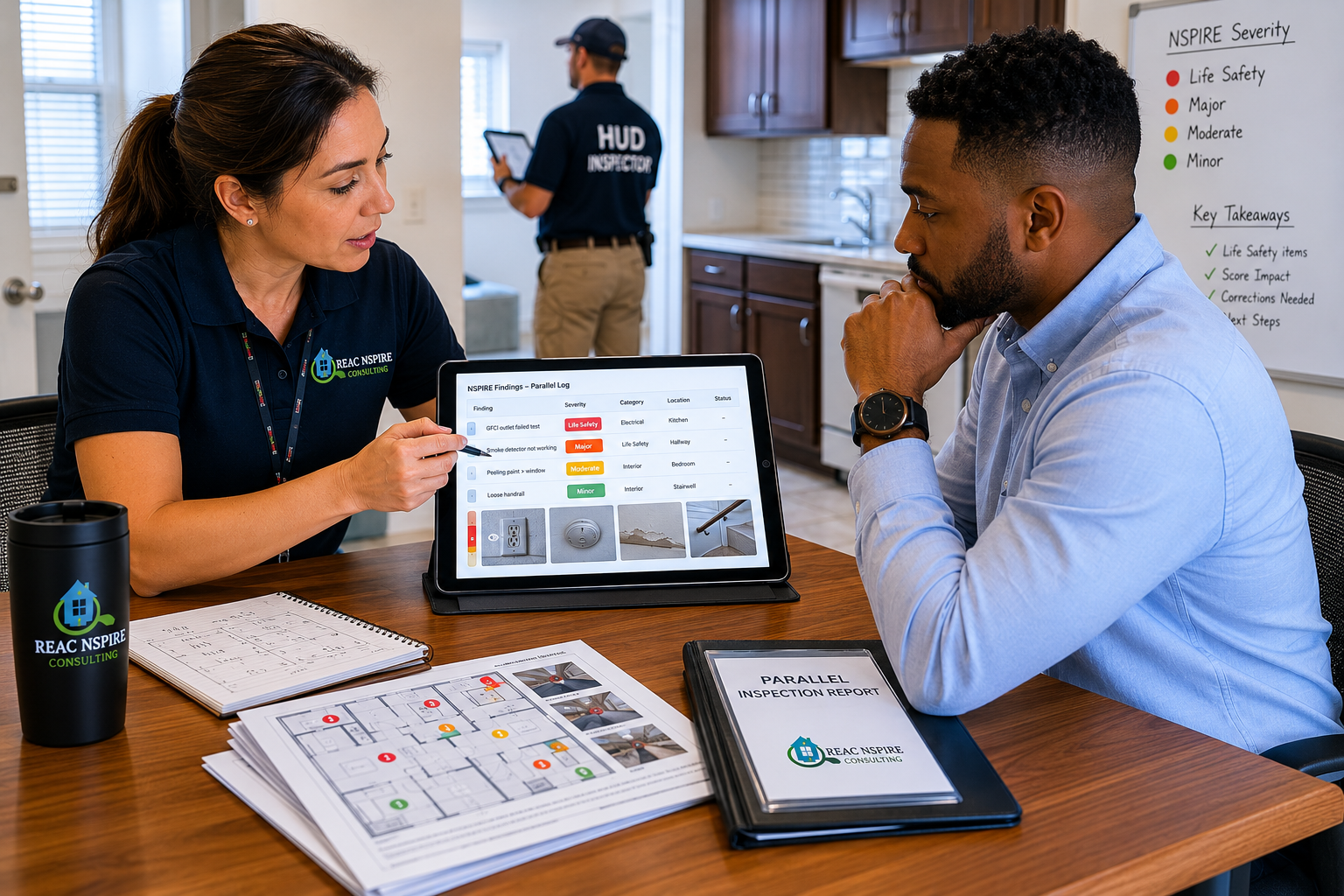
Nationwide capacity
What "nationwide" means when 50+ consultants sit behind it
Property managers evaluating national options usually find the same pattern: a nationwide claim, dispatched from one city by a small team. The result is scheduling delays, travel fees added after the quote, and regional subcontractors applying different standards to different properties.
We operate with a staffed team deployable to any state, at the same flat rate, under the same scoring framework. That is the difference between a nationwide claim and nationwide capacity.
- One report format across every property and every state
- The same four severity classifications, with no regional interpretation
- Flat rate covering travel, survey, report and follow-up
- Same-day mobilisation for Northeast properties from Philadelphia
- One point of contact rather than a firm per region
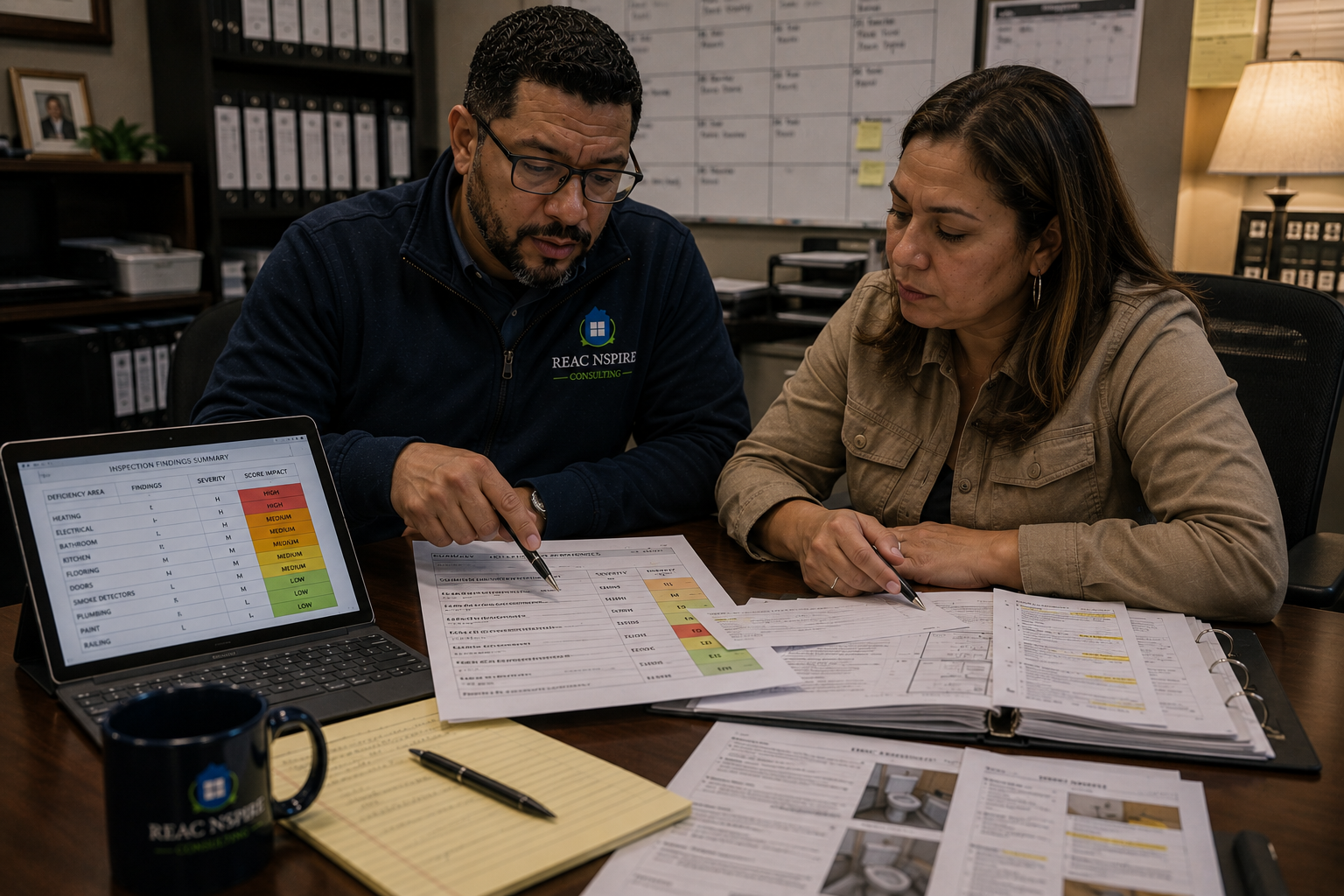
Multi-state portfolios
Three regional firms, three incompatible reports
A compliance director came to us after running pre-inspection prep through three separate regional consultants. Each used a different template, different deficiency category names, different severity labels, and a different way of expressing what a finding costs.
When she sat down to compare exposure across the portfolio, the reports did not line up. One called a finding an electrical panel deficiency at moderate severity. Another called the same condition a systems component below standard. The third did not classify it at all.
She spent two weeks translating before she could begin prioritising remediation money. That is a real cost and an entirely avoidable one.
Every report we produce uses the same structure, whether the property is a high-rise in Newark or a scattered-site authority in Texas. A compliance director comparing two properties in different states reads one framework and needs no translation.
Verify your state, get a quote, schedule the assessment
Tell us your property type, state and inspection window. We confirm scheduling and next steps within one business day.
Frequently asked
REAC inspection questions
What is a REAC inspection?
HUD's physical condition inspection of a property in a federal housing programme, conducted by or on behalf of the Real Estate Assessment Center and producing a score out of 100. The site, building, common areas and a random sample of units are examined against published standards.
Since October 2023 those inspections apply the NSPIRE protocol rather than UPCS. REAC is the office; NSPIRE is the standard it applies.
What is the difference between REAC and NSPIRE?
They are not alternatives. REAC is HUD's Real Estate Assessment Center, the office that inspects. NSPIRE is the current inspection standard, which replaced UPCS in October 2023.
People use the terms interchangeably because "REAC inspection" is what the industry has called it for twenty years. The inspection still happens; the protocol behind it changed.
How is a REAC inspection scored?
From 100, with deductions per deficiency weighted by severity and by whether the defect sits in a unit, inside the building, or outside on the site. Below 60 is failing, and 30 or less is referred for enforcement review.
The condition most people miss: lose 30 or more points in the unit area alone and the score is adjusted down to 59 regardless of how the rest of the property scored.
What is a good REAC score?
Sixty is the pass mark, and ninety or above has always been the benchmark for a well-run property. Under the legacy framework a score above ninety also bought a longer gap before the next inspection.
NSPIRE sets frequency by risk rather than by score band, so a strong score improves your risk profile without guaranteeing a three-year wait.
How do I prepare for a REAC inspection?
Survey first, rank by deduction, then repair in that order. Sixty to a hundred and twenty days ahead if you can, because the constraint is repair time rather than survey time.
What does not work is repairing what is most visible. Exterior work looks like progress and carries the lightest weighting of the three inspectable areas.
Can you evaluate my property before the official inspection?
That is the core of what we do. A pre-inspection survey applies the same protocol your inspector will, and returns findings ranked by score impact with photographic evidence for each one.
The point is not to list everything wrong with the property. It is to tell you which items will actually cost you points, and in what order to close them.
Can a REAC score be appealed?
On specific grounds, yes. Conditions permitted by local code, matters demonstrably outside the owner's control, and work already documented as in progress are all legitimate bases.
Filing on everything weakens the points that would have succeeded. Score appeal consulting covers which of your findings meet that test.
Do you work outside the Northeast?
All 50 states, with 50+ consultants and no regional exceptions. The flat rate applies equally whether the property is in Newark or Bakersfield, with no travel surcharge and no referral to a regional partner.