
NSPIRE inspection
Three inspectable areas. They do not count equally.
NSPIRE scores the unit, the inside of the building and the outside site separately, and weights them differently. Preparing the wrong one first is how properties do a great deal of work and still score badly. We survey all three the way HUD does, and report in 48 hours.

Try it
What gets inspected, area by area
Pick an inspectable area to see what falls inside it, how heavily it counts, and what most often goes wrong there. This is the part of NSPIRE most preparation gets backwards.
—
Deficiencies are recorded against the area they are found in, and each area contributes differently to the final score. Findings listed here are the ones we encounter most often, not an exhaustive list of what an inspector may record.
Try it
Why the same defect costs different amounts
Tick findings to watch how severity and location change the result. The point is the mechanic, not the number: notice that moving a finding from outside to inside a unit costs more, and that severity outweighs quantity.
Illustrative only. The weightings below are a teaching model built to show how severity and location interact. They are not HUD's published values and will not predict your score.
What this model does reflect accurately: severity matters more than the number of findings, the same defect costs more inside a unit than outside on the site, and life-threatening items carry a 24-hour clock as well as a deduction.
What NSPIRE is
The standard, not the office
NSPIRE stands for the National Standards for the Physical Inspection of Real Estate. It is the protocol HUD applies when inspecting assisted housing, and it replaced UPCS, the Uniform Physical Condition Standards, in October 2023.
It is worth being precise about this because the terms get used interchangeably and it causes real confusion. REAC is HUD's Real Estate Assessment Center, the office that conducts inspections. NSPIRE is the standard that office now applies. UPCS is what NSPIRE replaced. If someone tells you NSPIRE replaced REAC, they have the relationship wrong.
What changed in practice is emphasis. NSPIRE assesses health, safety and functional performance rather than appearance, weights findings by severity rather than counting them, and places the heaviest weighting on conditions inside the dwelling unit, where residents actually live.
That last point is the one that catches properties out. Under the old approach, exterior and common-area presentation carried more relative influence. Preparation built on that instinct produces a tidy site and a disappointing score.
If your inspection has already happened and the result looks wrong, score appeal consulting covers the grounds that succeed. For the wider regulatory picture beyond physical condition, see HUD compliance audit.
Severity
Four tiers, four correction windows
Severity decides both the deduction and how long you have. Every consultant on our team classifies against these four, with no regional interpretation.
Life-threatening
Immediate risk to residents. Exposed conductors, blocked egress, gas leaks, missing or non-functioning alarms.
Severe
Significant defects affecting health, safety or the function of a building system, without that immediacy.
Moderate
Defects reducing the condition or usability of a unit, area or component without a direct safety risk.
Low
Minor defects with limited impact on health, safety or function. Still recorded and still deducted.
The standard we apply
Rural Oklahoma and urban New York, identically
Same deficiency categories, same severity classifications, same deliverable, wherever the property sits.
All three inspectable areas covered
Unit, inside and outside reviewed against current NSPIRE deficiency definitions rather than the retired UPCS categories a lot of published checklists still use.
Life-threatening triage first
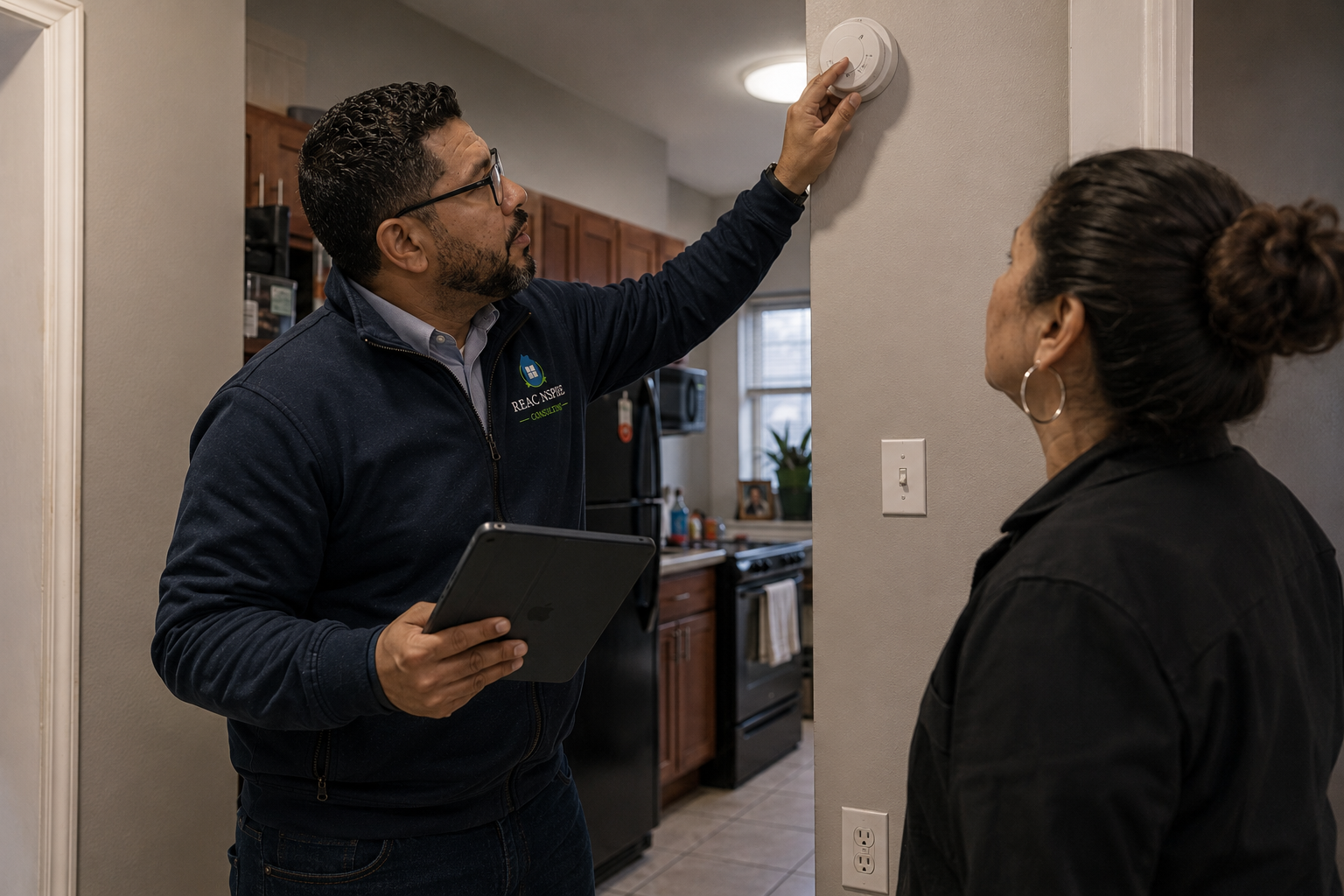
Smoke alarms, carbon monoxide detection, egress paths and fire suppression assessed at the start of every walkthrough, because those carry a 24-hour clock and everything else can wait for them.
Severity classification on every finding
Each deficiency ranked life-threatening, severe, moderate or low, consistent with the classifications HUD applies, so the report reads in the same vocabulary as the eventual inspection.
Photographic documentation
Every deficiency photographed and included in the report. No written finding without visual evidence, which matters both for your crew and for any later challenge.
Remediation ranked by score impact
Fixes ordered by what each removes from the score, not by where it sits in the building. That ordering is the difference between a list of faults and a work sequence.
48-hour written report
Structured in NSPIRE deficiency language, suitable for ownership reporting, board presentations or a Corrective Action Plan submission without rewriting.
Inside our engagement
Three stages, one documented standard
Confirmed within 24 hours
We collect location, programme type, unit count and your approximate inspection timeline, then confirm field availability. If your window is tight we say so on that call.
The same sequence every time
Life-threatening triage first, then building systems and site exterior, which are the two areas internal teams most often under-prepare, then the unit sample.
Structured for immediate use
Delivered in 48 hours, organised by severity rather than by building location, with life-threatening findings at the top and photographic evidence throughout.
Coverage
It is not availability. It is routing.
A national field operation is not a matter of having somebody available in the area. It is a matter of how consultants are routed, and that is what decides whether a property in Oregon waits three weeks or three days.
We route from regional staging points rather than only from Philadelphia. Properties in the Southeast, Midwest, Southwest and Pacific Northwest get comparable scheduling windows instead of extended lead times, and the flat rate applies with no distance surcharge.
- One coordinated field team, not a referral network
- One report format and one severity classification throughout
- Scheduling opens within 24 hours of enquiry
- Multi-state portfolios handled as a single engagement
- No geographic exclusions and no travel surcharge
I've walked properties where the management team hadn't seen a qualified NSPIRE consultant in person. Not because they weren't looking, but because there wasn't one to find.Sam AmoyelleFounder, REAC Nspire Pros
Areas we serve
Every state, same standard, same flat rate
Engagements run identically whether the property is in Philadelphia, rural Oklahoma or coastal California.
Confirm coverage for your state in one call
Tell us your property type, unit count, state and inspection window. Scheduling is confirmed within 24 hours.
Frequently asked
NSPIRE inspection questions
What is an NSPIRE inspection?
A physical inspection of HUD-assisted housing conducted against the National Standards for the Physical Inspection of Real Estate. It covers three inspectable areas — inside the unit, inside the building, and outside — and scores findings by severity.
NSPIRE replaced UPCS in October 2023. It is the standard, not the office: REAC conducts the inspection, NSPIRE is what it applies.
What are the NSPIRE inspection requirements?
The property has to meet published standards for each inspectable item in each of the three areas, with health, safety and functional performance the governing test rather than appearance.
From 1 October 2026 a further set of affirmative requirements begins carrying deductions in Public Housing and Multifamily inspections, covering fire labelled doors, GFCI and AFCI protection, guardrails, HVAC, interior lighting, and minimum electrical provision. These have been inspected all along; what changes is that they start affecting the score.
Which inspectable area matters most?
Inside the unit. NSPIRE places the heaviest weighting there because it is where residents actually live, and there is a further rule most properties do not know about: lose 30 or more points in the unit area alone and the score is adjusted down to 59 regardless of how the rest of the property performed.
That is why exterior-first preparation, which feels productive and looks like progress, so often produces a disappointing result.
How long does scheduling take for a property far from Philadelphia?
Scheduling is confirmed within 24 hours of enquiry regardless of state, because consultants route from regional staging points rather than all from headquarters.
Distance affects which consultant attends, not how long you wait or what you pay.
How do we know every consultant follows the same standard?
Because the classification system is not left to judgement. Every finding is scored against the same four severity tiers and the same deficiency definitions, and every report uses the same structure.
That is the practical difference between a coordinated field team and a referral network: with subcontractors, two properties in two states produce two documents you cannot compare.
Why not hire a local building inspector instead?
A building inspector assesses against local code. An NSPIRE consultant assesses against the federal standard your score is calculated from, and those two things overlap without being the same.
A property can be fully code-compliant and still lose points, because NSPIRE tests items and conditions local code does not address.
Can one engagement cover properties in several states?
Yes, and that is where the reporting consistency earns its keep. One engagement, coordinated scheduling, and results in a single format so you can compare properties against each other.
When the same finding appears at several sites, the cause is usually one specification or one supplier rather than several unrelated lapses, and you only see that when the reports match.
What does it cost outside the Northeast?
The same. Flat rate in every state, with no geographic surcharge, no travel fee and no variable charge based on distance. One price confirmed before any consultant is scheduled.