
HCV compliance
A failed voucher unit stops the payment
Not a score, not a warning. The housing assistance payment is the whole reason Section 8 participation is worth it, and a failed inspection interrupts it while the correction clock runs. We survey the unit against the standard your authority actually applies.

Try it
The same unit, judged two different ways
Switch the standard to see how the same set of conditions is treated. This is why landlords who passed for a decade start receiving failure notices without anything about the property changing.
—
Illustrative comparison of how the two frameworks handle the same conditions. Which applies to your unit depends on your housing authority, and severity classifications are set by HUD rather than by us.
The part most advice gets wrong
NSPIRE has not arrived everywhere yet
The regulation defining Housing Quality Standards now refers to the NSPIRE standards, so the text has changed. But HUD has deferred the compliance date for the voucher programmes three times, and it currently sits at 1 February 2027.
Still on legacy criteria
Your authority may keep inspecting to the familiar HQS performance areas until the compliance date, and many are doing exactly that.
What to do: prepare to the checklist you know, and do not spend against NSPIRE weighting yet.
Transitioned early
An authority may adopt the NSPIRE-referenced definition ahead of the deadline, having notified HUD of its transition date. This is where first-time failure notices are coming from.
What to do: a legacy checklist will leave gaps. Severity and placement matter more than presence.
Everyone, eventually
The current compliance date for voucher, project-based voucher and moderate rehabilitation programmes. It has moved three times already.
What to do: ask your authority two questions. Have you transitioned, and what is on your life-threatening list.
Both common claims are wrong. Anyone telling you HQS is unchanged is out of date, because the regulation text did change. Anyone telling you your unit is already judged against NSPIRE is ahead of the facts, because the compliance date has not arrived.
Both errors cost money in opposite directions. Prepare to the wrong standard and you spend on the wrong items; assume nothing has changed and you are unready when it does. The only reliable answer comes from your own authority, and it is a two-question phone call rather than a research project.
What is at stake
Failure stops income, not points
On a scored inspection a poor result costs points and attracts attention. On a voucher unit, a failure can interrupt the assistance payment while the correction period runs, which makes the consequence immediate rather than eventual.
The correction windows are short and specific, and they run from the finding rather than from when you get round to reading the notice. Life-threatening items carry 24 hours. Most other findings carry 30 days, or another reasonable period the authority sets.
A month of interrupted assistance on a unit is usually far more than the repair that caused it. That is the entire economic argument for surveying before the official visit rather than after.
Experienced landlords are not failing because their properties declined. They are failing because a standard changed underneath them, and because alarm placement, protection devices and egress function are assessed more precisely than most people expect.
Where assistance attaches to the building rather than the household, PBV compliance applies instead. For the physical survey itself, see HQS inspection.
Standards
How we walk, score and document every unit
Every pre-inspection follows the unit checklist rather than a generalised building walkthrough, because a voucher inspection is about one dwelling rather than a portfolio.
Life-safety first
Smoke alarms, carbon monoxide detection, egress windows and electrical hazards are checked before anything else, because they carry the shortest correction window and the heaviest consequence.
Placement and function, not just presence
A device that exists is not the test. We check location against the requirement for each room type and layout, and confirm it actually works rather than that it is mounted. Expired sealed units are the single most common miss we find.
Structural and mechanical elements
Plumbing, heating and cooling components, ceilings, walls and floors reviewed against the severity criteria your authority is applying, so the findings match the framework you will be judged by.
Photographic documentation
Every deficiency photographed and every pass condition recorded. The written report is defensible in correspondence with the authority, which matters where a finding is arguable.
Prioritised remediation guidance
The report tells you what to fix first, ranked by severity rather than alphabetically or by room. A list of faults becomes a work sequence.
Written for whoever does the work
Findings expressed in plain terms a contractor or handyman can act on directly, without needing the regulation explained first. Most voucher landlords are not running a maintenance department.
Inside our engagement
Three stages, built around your inspection date
One call to book the walkthrough
Tell us your location, unit count and expected inspection date. We confirm scheduling within one business day, and we ask which authority administers your voucher so we survey against the right standard.
Written, inside 48 hours
What the report contains:
- Every deficiency found, with its severity classification
- A photograph of each one
- The order to fix them in, ranked by consequence
- Plain-language description of the correction needed
Confirmed before the official visit
After repairs, a second walkthrough confirms every documented deficiency has actually been resolved, so the first time anyone checks the work is not the day it counts.
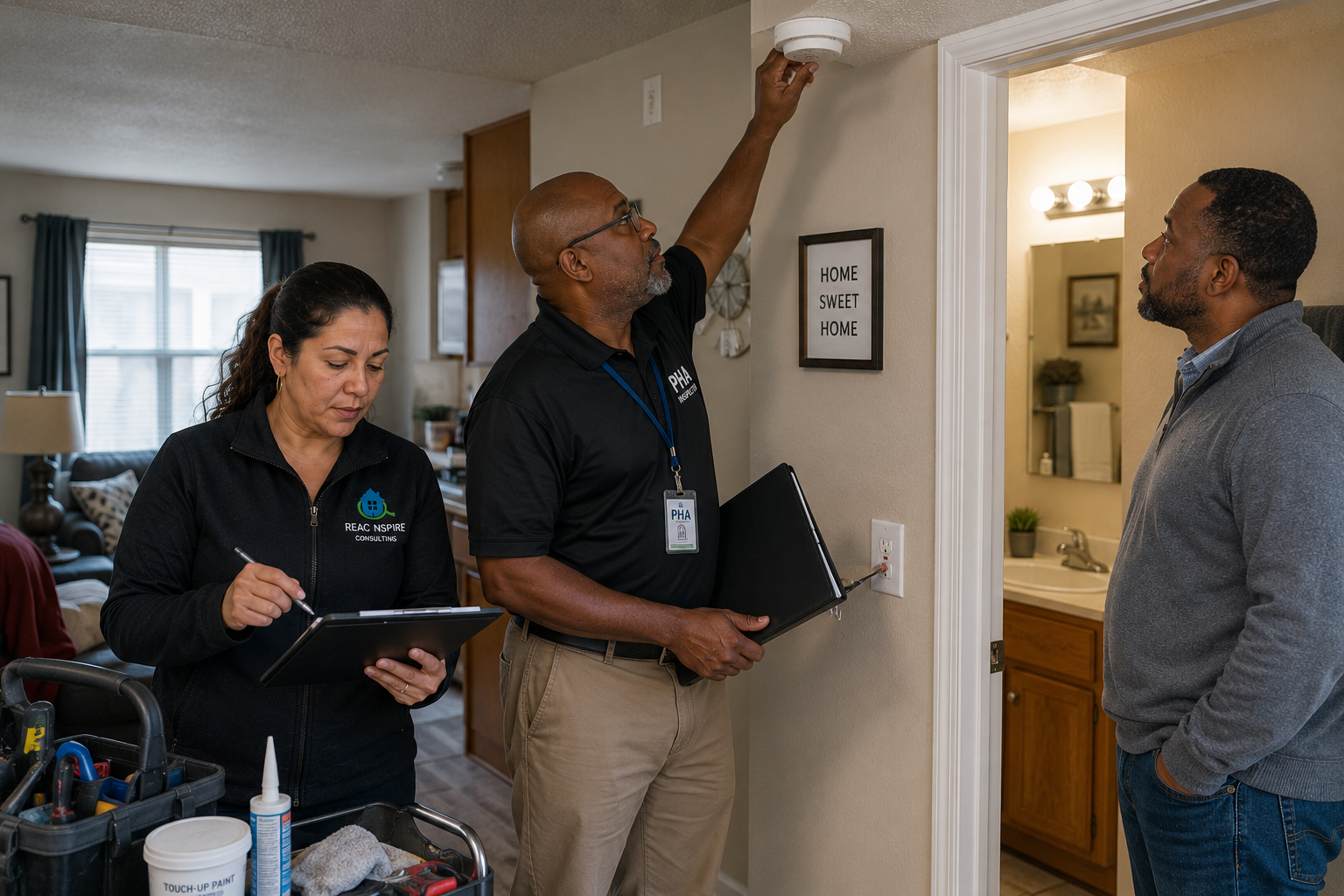
Both sides of the table
We have worked on the authority side too
A public housing authority is the local agency that schedules and manages unit inspections for voucher holders in its area. We have worked with authorities administering voucher programmes and overseeing landlord inspections, preparing their own portfolio properties.
That matters because the authority's administrative plan is what actually governs your inspection: how often it happens, what has been added to the life-threatening list, and whether the authority has transitioned on physical standards at all.
Working on that side is how we know which items generate findings in practice rather than in theory, and that goes into every landlord walkthrough we do.
- We establish which standard your authority applies before surveying
- Local additions to the life-threatening list are checked, not assumed
- Findings expressed the way your authority expresses them
- Re-inspection support before the official visit
Experienced landlords consistently miss alarm placement, and it is the most costly miss possible.Sam AmoyelleOwner, REAC Nspire Pros
Areas we serve
Every state, same standard, same flat rate
Strongest concentration in the Mid-Atlantic corridor, with a national field network covering everywhere else on the same terms.
Protect the payment, not just the tenancy
Tell us your unit count, state and inspection timeline. We confirm scheduling within one business day.
Frequently asked
HCV compliance questions
Is my voucher unit judged against HQS or NSPIRE?
Whichever your housing authority is currently applying, and that is a genuine question rather than a formality. The regulation now refers to the NSPIRE standards, but HUD has deferred the compliance date three times and it currently sits at 1 February 2027.
Some authorities transitioned early after notifying HUD. Most have not. Ask yours directly, because preparing to the wrong one wastes money in both directions.
My unit passed HQS for years. Why am I failing now?
If your authority has transitioned, the framework changed rather than your property. Alarm placement, protection devices and egress function are assessed more precisely, and conditions that passed as acceptable are now recorded as deficiencies with a severity attached.
If your authority has not transitioned, something else is going on and it is worth establishing what before spending on remediation.
What does an HCV consultation cost?
Flat rate per unit, with no per-unit surcharges and no variable charge based on what is found. One price confirmed before anyone visits.
Call or email with your unit count, state and inspection timeline for a direct quote.
How quickly can we go from first contact to a written report?
Scheduling is confirmed within one business day and the written report follows within 48 hours of the walkthrough. For a single unit the whole sequence is usually under a week.
If your inspection date is too close for repairs to be completed in time, we say so on the first call rather than after you have paid.
Is the report specific enough for my contractor to act on?
That is what it is written for. Each finding names the condition, its location, its severity and the correction needed, in plain terms rather than regulatory language, with a photograph attached.
Most voucher landlords are not running a maintenance department, so a report that needs interpreting before anyone can start is not much use.
How do you know what my PHA looks for?
We ask, and we check the administrative plan where it is available. That document sets inspection frequency and records any items the authority has added to its life-threatening list beyond the standard set.
We have also worked on the authority side, preparing housing authority portfolios, which is how we know which items generate findings in practice rather than in theory.
What if the unit still has issues after I complete the repairs?
That is what the re-inspection is for. A second walkthrough after repairs confirms each documented deficiency has actually been resolved, so the official visit is not the first time anyone checks the work.
Where a repair has not fully addressed the finding, you learn it while there is still time rather than on the day.
How often will my unit be inspected?
At least biennially under the programme, though many authorities inspect annually and more often where there is a history of findings.
Your authority's administrative plan is what actually decides it, and intervals vary more between authorities than most landlords expect.