
REAC Mock Inspection Services for Legacy Compliance Properties
Still on a legacy REAC cycle? Get a full REAC mock inspection with a predicted score and ranked deficiency list.

Your REAC Score Is Predictable. Know It Before HUD Does.
A REAC mock inspection gives properties still on active legacy inspection cycles a predicted physical condition score before HUD arrives.
A REAC mock inspection is a full simulation of the Real Estate Assessment Center’s scoring matrix, deficiency cataloging protocol, and inspector walkthrough methodology. This service is built for one specific property type: HUD-regulated housing still operating under an active REAC inspection cycle, not yet transitioned to NSPIRE.
If your property’s next scheduled inspection runs under the legacy REAC scoring framework, this page is written for you.
REAC Nspire Pros has run REAC-standard assessments since 2000. That’s not a marketing figure. It means this firm has seen every major scoring methodology update, every deficiency reclassification, and every shift in how REAC inspectors apply the rules in the field.
Knowing the standard and knowing how an inspector applies it to your specific building are two entirely different things. The mock inspection bridges that gap.


Active REAC Cycles in the Northeast Corridor Require a Different Level of Familiarity.
The Mid-Atlantic and Northeast corridors carry some of the highest concentrations of legacy REAC-cycle properties in the country — and REAC Nspire Pros operates directly inside that geography.
Our Philadelphia dispatch hub puts us within immediate reach of New Jersey-based housing authorities — including active client relationships with Freehold Housing Authority and Trenton Housing Authority. Both have operated under REAC inspection cycles while navigating the broader HUD transition. Our consultants are working with REAC-standard properties right now, in this region, not in theory.
The Northeast’s older affordable housing stock — pre-1970s masonry construction, aging building systems, dense unit configurations — produces specific deficiency accumulation patterns. Common areas in high-occupancy buildings develop score-eroding findings that cluster in ways a property’s own team rarely maps across the full inspectable area, the defined inspection zones REAC uses to divide and score a property.
We know those patterns. We’ve documented them in this building stock for decades.
I've Seen the Same Buildings Pass and Fail the Same Inspection Standard. Here's the Difference.
The gap between a 79 and an 83 is often invisible to the people who work in the building every day.
My name is Sam Amoyelle. I’ve been running REAC-standard assessments since 2000. The pattern I’ve seen repeat across hundreds of properties is this: internal teams are excellent at identifying the obvious, high-effort deficiencies. The cracked stair tread. The missing outlet cover. The broken light fixture in the laundry room. Those get fixed before any inspection.
What pulls scores into the low 70s is different. It’s the accumulation of low-severity findings across common areas — a building inspectable area that carries significant scoring weight within the REAC scoring matrix, the point-based system REAC inspectors use to calculate a property’s physical condition score.
I walked a mid-size property in the NJ-PA corridor. The compliance director was confident. They’d completed three self-guided walkthroughs. Their maintenance log was clean. When I ran the REAC simulation, the site area alone carried seven findings they hadn’t documented — each individually minor, but collectively pulling the predicted physical condition score, the numerical 0-to-100 result of the inspection, from 81 to 74.
That’s the difference between annual inspections and biennial inspections. Inspection frequency is HUD’s policy of adjusting how often a property is inspected based on prior scores. That gap is not cosmetic.
After the mock walkthrough, we produced the deficiency catalog — the structured list of all findings organized by inspectable area and severity — ranked by score impact. The maintenance team had a clear execution sequence. When HUD arrived, the property scored 84.
The items that moved the score weren’t the ones anyone expected to find.

Your Maintenance Team Knows the Building. We Know How the Inspector Reads It.
There is no conflict between a strong internal maintenance program and a REAC mock inspection — they work from different vantage points.
A maintenance team’s job is to keep the building operational and respond to resident needs. They walk the building with operational eyes. An inspector walks it with scoring eyes — measuring against the REAC walkthrough protocol, the standardized sequence a REAC inspector follows when moving through a property, recording every finding against the inspectable area weighting that determines how much each zone contributes to the final score.
Those two modes of observation produce different lists. That’s a structural fact about how REAC scoring works.
The mock inspection produces findings organized in the exact sequence a REAC inspector would document them — by inspectable area, by severity, by point impact. Your team receives a remediation list they can execute starting day one, in the order that protects the most points first.
Properties with strong maintenance histories that still scored unexpectedly low under REAC use this process to get ahead of that outcome.
Our REAC Simulation Standards
Flat-rate pricing applies regardless of what the walkthrough finds. The invoice is not affected by deficiency count.
Every REAC mock inspection from REAC Nspire Pros follows the same protocol — no shortcuts based on property size or condition.
How a REAC Mock Inspection Works

Diagnostic Assessment
The engagement begins with a pre-walkthrough intake. We collect the property’s program type, unit count, construction era, prior REAC inspection history, and most recent physical condition score. This shapes the inspection frequency context and tells us which inspectable areas have historically carried the most score risk for this building type.
We confirm the unit sample size based on property scale and conduct the site, exterior, and building systems assessment before entering residential units. Findings are recorded in real time using the REAC scoring matrix — no post-walk reconstruction.
Implementation
Inside units, we apply the full REAC unit inspection sequence. This is a scoring simulation, not a condition survey. Every item a REAC inspector is required to check, we check. Items a REAC inspector would score as a deficiency get logged with their severity classification and point weight.
Common areas receive the same rigor. Accumulated low-severity findings most often surprise property teams here — because individual items appear minor and get deferred, but five deferred items in the same inspectable area create a different scoring outcome than one major finding.
Building systems are assessed against the operational and safety requirements REAC applies at inspection — including heating and cooling, plumbing, and electrical common-area components.
Post-Service Testing and Reporting
After the walkthrough, the full deficiency catalog is assembled and scored against the REAC scoring matrix. The predicted physical condition score is calculated using the same algorithm HUD applies. The written report includes every finding, its inspectable area classification, its severity level, its estimated point impact, and the recommended remediation action.
The remediation sequence — the order in which repairs should be completed — is organized by point impact, not by physical proximity or ease of access. The highest-point findings appear at the top. Your team starts there.
Report delivered within 48 hours of walkthrough completion. Digital delivery. Photographic documentation included for every documented finding.
Areas We Serve
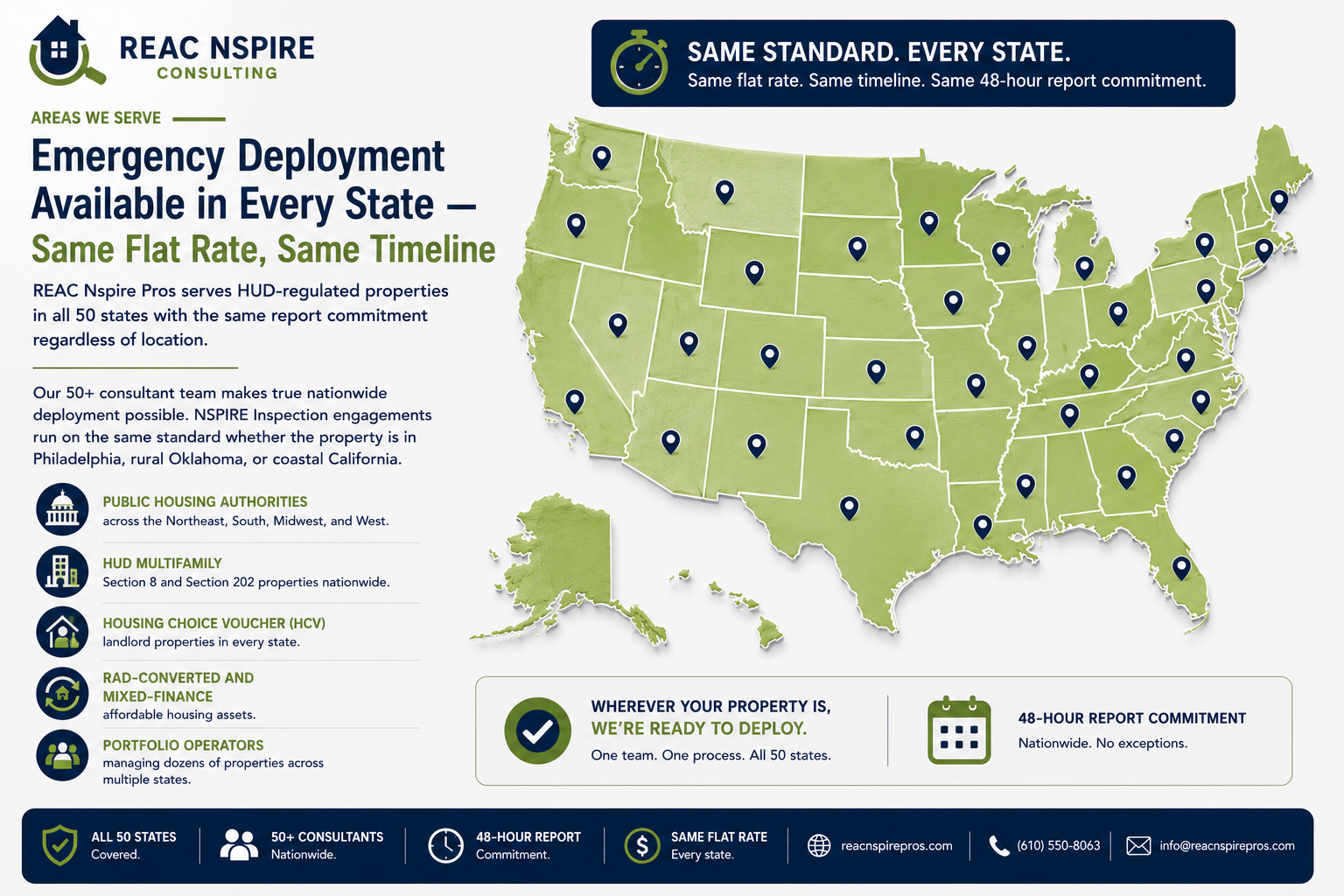
REAC Nspire Pros serves legacy REAC-cycle properties across all 50 states. Our dispatch hub is in Philadelphia, which gives us direct deployment capability across the Northeast and Mid-Atlantic — including New Jersey, Pennsylvania, New York, Maryland, and Delaware. Our 50+ field consultants serve housing authorities and property management companies in every U.S. state.
- New Jersey & Pennsylvania
- New York & Mid-Atlantic
- Southeast & Sun Belt
- All other states via our network
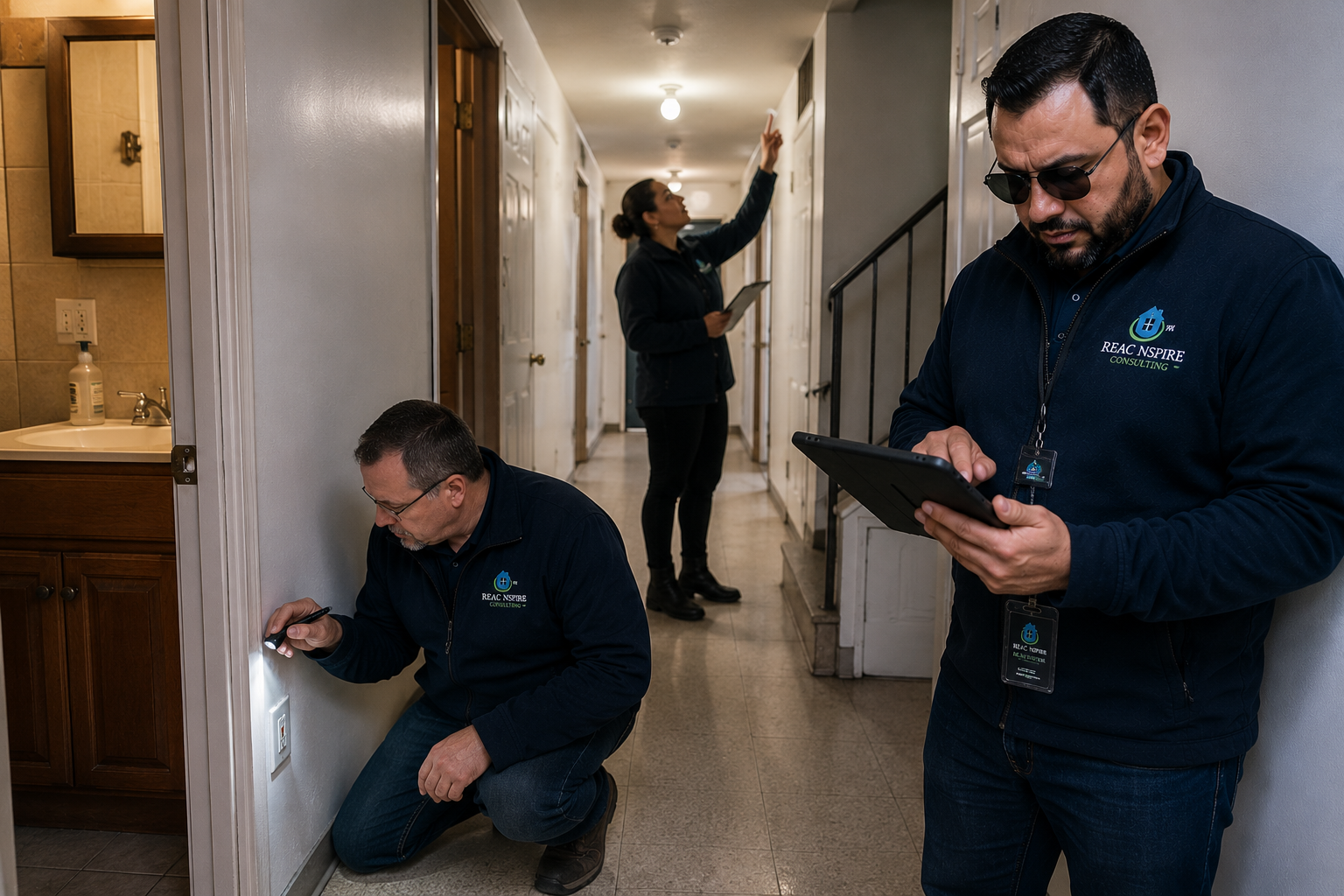
What our work looks like.
From on-site assessment through written report delivery — every engagement runs on the same documented standard.
On-Site Walkthrough
Every inspectable area covered using HUD’s NSPIRE deficiency protocol — same lens your inspector applies.

Scored Report
Findings ranked by score impact. Your team sees what carries the most points before day one.

Follow-Up Support
Engagement continues through your inspection date. Questions answered. Documentation guided.
Common questions, direct answers.
If your question isn’t here, call (610)-200-2836 and a consultant will respond directly.
REAC Nspire Pros charges a flat rate for every REAC mock inspection engagement. The price does not change based on deficiency count or property condition. Flat-rate pricing means your budget is set before the consultant walks the door. Contact us at (610)-200-2836 for a project quote based on your property’s unit count and location.
Most clients receive their written report within 48 hours of the completed walkthrough. Scheduling depends on your property’s location and current availability. For properties with an imminent inspection date, contact us immediately – our 50-plus field consultants serve all 50 states and can prioritize urgent engagements.
Yes – the output includes a predicted physical condition score, not just a deficiency list. Every finding is scored against the actual REAC scoring matrix. The report shows exactly how much each deficiency affects your predicted score, so remediation decisions are based on point impact, not guesswork.
Two years of occupancy creates new findings. Common-area deficiencies accumulate between cycles in ways routine maintenance logs rarely capture. A prior passing score does not predict your current score. The mock inspection maps what the building looks like right now, against what the inspector will score.
A standard property condition assessment documents building condition for maintenance or lending purposes. A REAC mock inspection replicates the exact walkthrough sequence, scoring matrix, and deficiency classification system a REAC inspector uses. The output is a predicted HUD physical condition score – not a general maintenance report.
Unit sampling follows HUD’s statistical formula based on your property’s total unit count – the same method HUD’s own inspectors apply. No self-selected representative sample is used. Site, building exterior, building systems, and common areas are fully assessed regardless of property size.
Ready to Know Your Score Before HUD Does?
Tell us your property type, state, and inspection window. We’ll confirm scheduling and next steps within one business day.